

elitarot2strikingly.com
Above all things, Know Thyself!
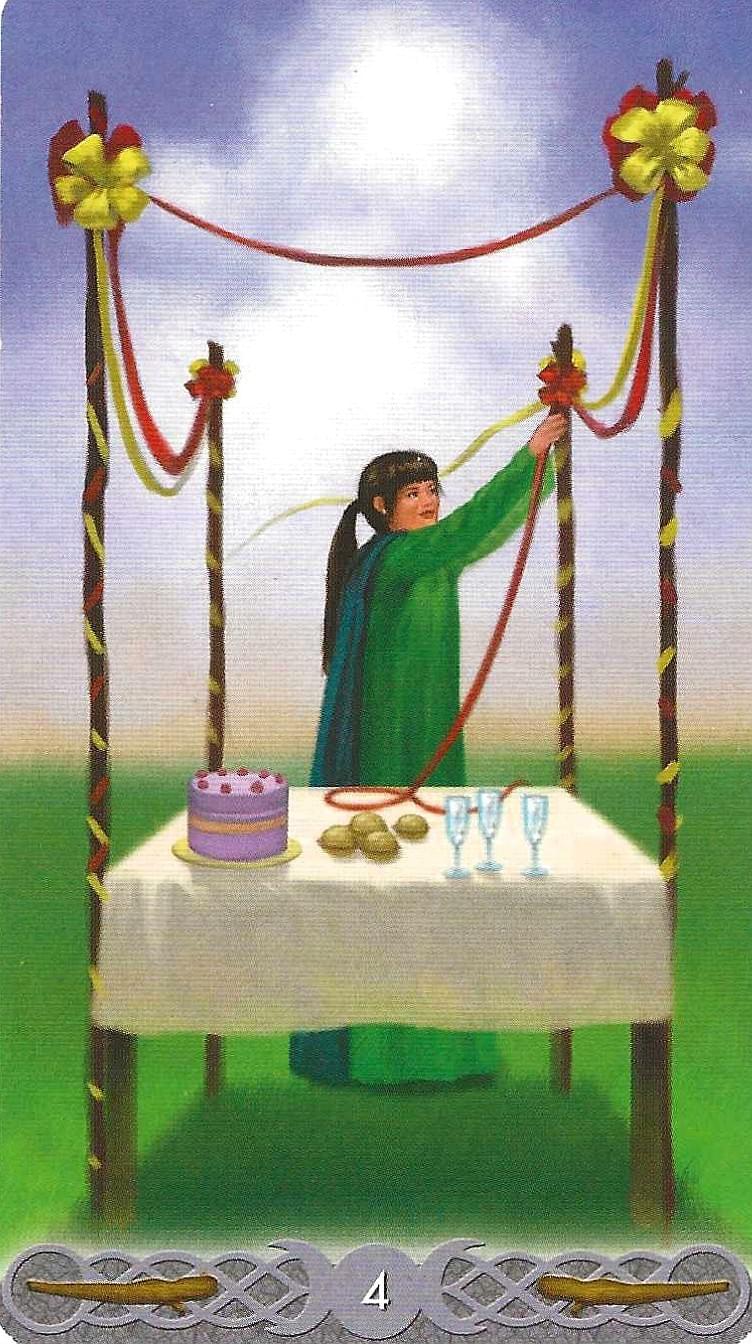

The Rider-Waite-Smith Tarot- 4 of Wands
True to the Rider-Waite-Smith Cards tradition the 4 of Wands represents the minimal meanings with a hint of esoteric leaving out the more detailed image explanations of the Western Hermetic occult meanings that are presented on the Thoth Cards. This is because of Waites sworn lodge oath to not reveal the lodge secrets.

Rider-Waite-Smith Tarot – Four of Wands
Stability with Open Gates
True to the Rider-Waite-Smith tradition, the Four of Wands presents its meanings in a deliberately restrained manner—offering a stable, accessible symbolism while leaving the deeper Western Hermetic mechanics largely implicit. This restraint is not accidental. Arthur Edward Waite was bound by sworn lodge oaths, and as such, the RWS deck consistently veils the more explicit occult formulae that Aleister Crowley later made transparent in the Thoth Tarot.
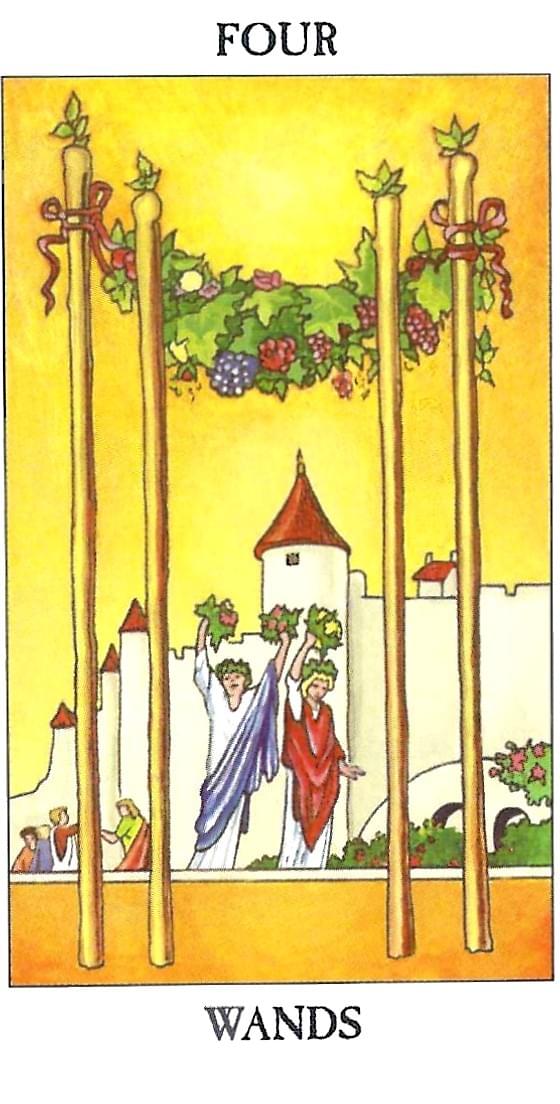
In the RWS Four of Wands, four staves are firmly implanted in the earth and crowned with a floral garland. This image immediately conveys fertility, fecundity, celebration, and established strength. The number four, across Hermetic systems, signifies completion, foundation, and power stabilized into form—a force no longer in flux, but momentarily at rest.

From a Qabalistic perspective, the Four of Wands corresponds to Chesed operating within the fiery world of Atziluth, a condition of benevolent order and harmonious expansion. Fire here is no longer explosive or initiating; it is contained, structured, and blessing-bearing. The Will (Wands/Fire) has found a functional framework in which it can express joy rather than struggle.
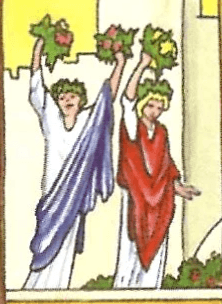
Prominently featured on the card are two female figures, each uplifting a nosegay—small bouquets of flowers traditionally associated with gifting, fragrance, and blessing. Their presence reinforces the theme of shared joy and communal stability. The nosegay is not merely decorative; it is a symbol of circulated abundance. Wealth, in this card, is not hoarded—it is offered, exchanged, and celebrated.
Behind the figures stands a bridge crossing a moat, leading toward an old manor house. This imagery strongly implies security, inheritance, and established prosperity. The manor represents a fortified center—a place of belonging—yet access to it is granted via a bridge.
This is a crucial distinction.
Ordinarily, the number four implies a closed system: four walls, four sides, containment and protection. This closed stability is emphasized in the Thoth Tarot’s Four of Wands (Completion), where the fiery forces are locked into a perfected geometric arrangement—power held firmly in equilibrium. The RWS card, however, subtly diverges. The four wands form not a sealed enclosure but an arbor or ceremonial gateway. Stability here is not defensive—it is welcoming.
The bridge over the moat suggests discernment rather than isolation. One is secure yet not cut off. This reflects a state of open-minded stability, where the Will is strong enough to invite others in without fear of collapse. It is the difference between a fortress and a sanctuary.
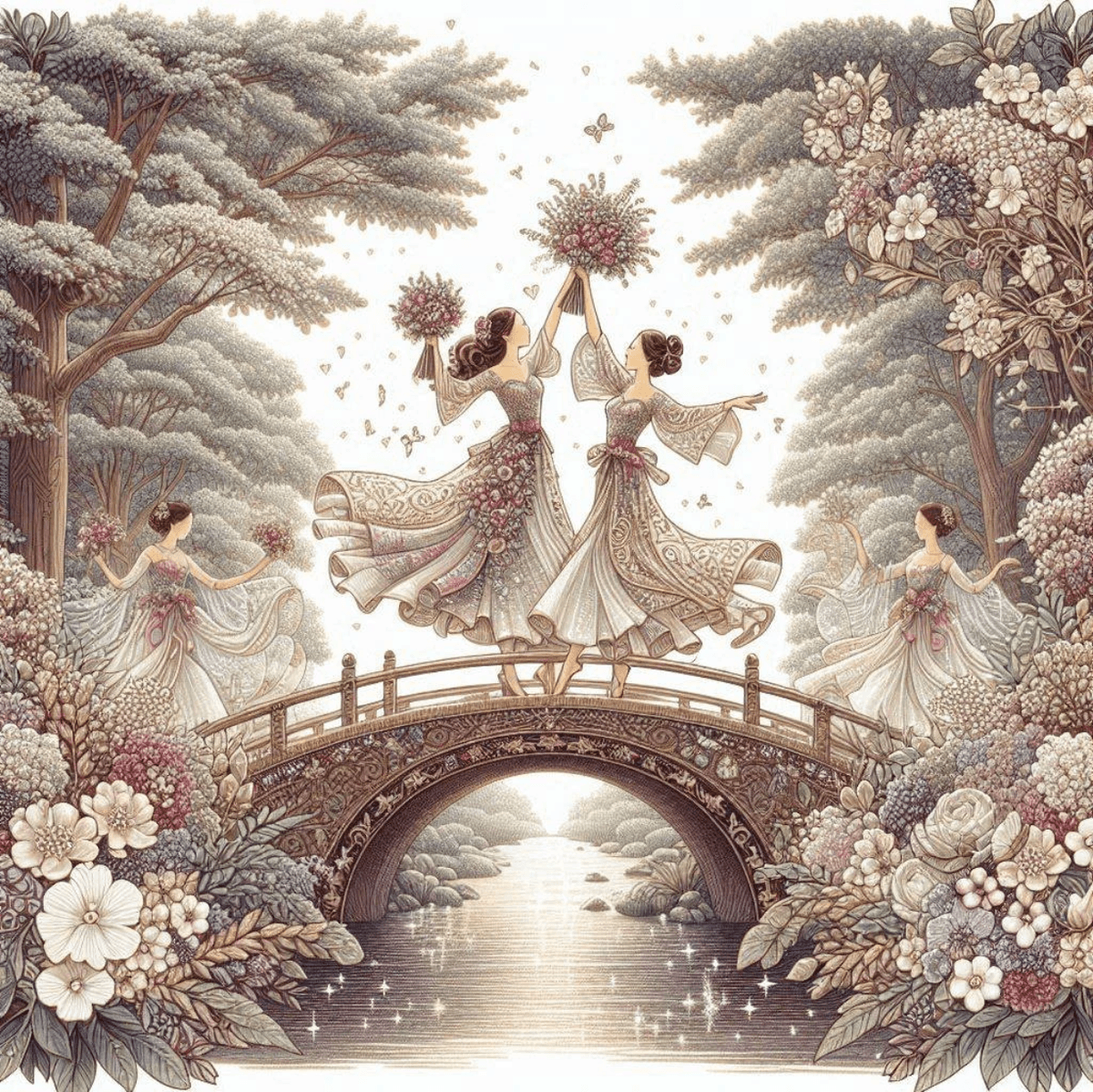
The nosegay further deepens this symbolism. Historically, nosegays were carried for protection, celebration, and fragrance, but also as symbols of intention and meaning. Each flower carried a message; each bouquet was a silent language. In esoteric terms, the nosegay functions as a portable talisman of harmony, blending beauty, scent, and symbolic resonance. It is Fire softened by Venusian grace—Will tempered by Love.
Thus, the Four of Wands in the Rider-Waite-Smith deck represents more than mere celebration or domestic happiness. It depicts a threshold moment: stability achieved, joy shared, and foundations strong enough to remain open rather than closed. Where the Thoth deck reveals the occult engineering of this state, the RWS deck shows us its lived experience.
In readings, this card points to harmony, shared success, and a safe container for growth—but with an important nuance: true power does not require isolation. The strongest structures are those that can afford to open their gates.

The Arbor of Blessing and the Gate of Chesed
In the Rider-Waite-Smith Tarot, the Four of Wands depicts four staves supporting an arbor heavy with fruitful grapevines. This image is deceptively simple, yet it carries layered symbolic meaning that bridges the material, social, and spiritual worlds.
At its most immediate level, the Four of Wands is a card of celebration, harmony, and joy. The grape-laden arbor signifies abundance and the visible fruits of prior effort. What was once an idea or aspiration has now ripened into something tangible. This is not the fire of striving, but the fire of enjoyment and shared success.
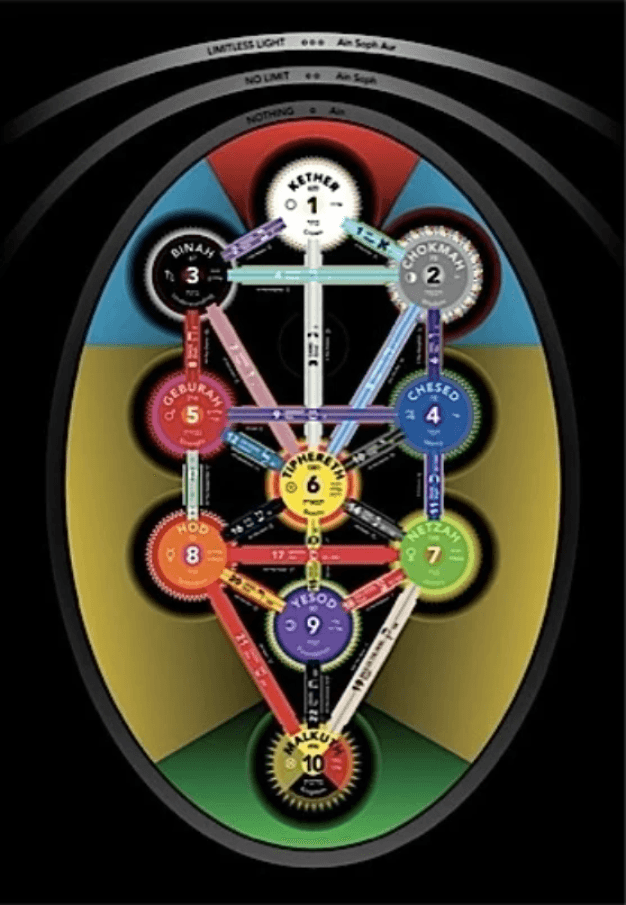
The number four is crucial. In Western Hermetic symbolism, four represents stability, completion, and manifestation—the establishment of form after movement. The four wands create a balanced structure, a temporary temple or ceremonial gateway, indicating that a phase of effort has reached coherence. The work has “taken shape,” and one may now pause to honor what has been achieved.
From a Qabalistic perspective, the Four of Wands reflects the influence of Chesed (Mercy) operating within the fiery suit of Wands. Chesed is expansive, benevolent, and generous; it is the Sephirah of blessing after force. Fire under Chesed becomes warmth rather than combustion, joy rather than struggle. This explains why the celebration shown here is communal rather than solitary—abundance naturally seeks to circulate.
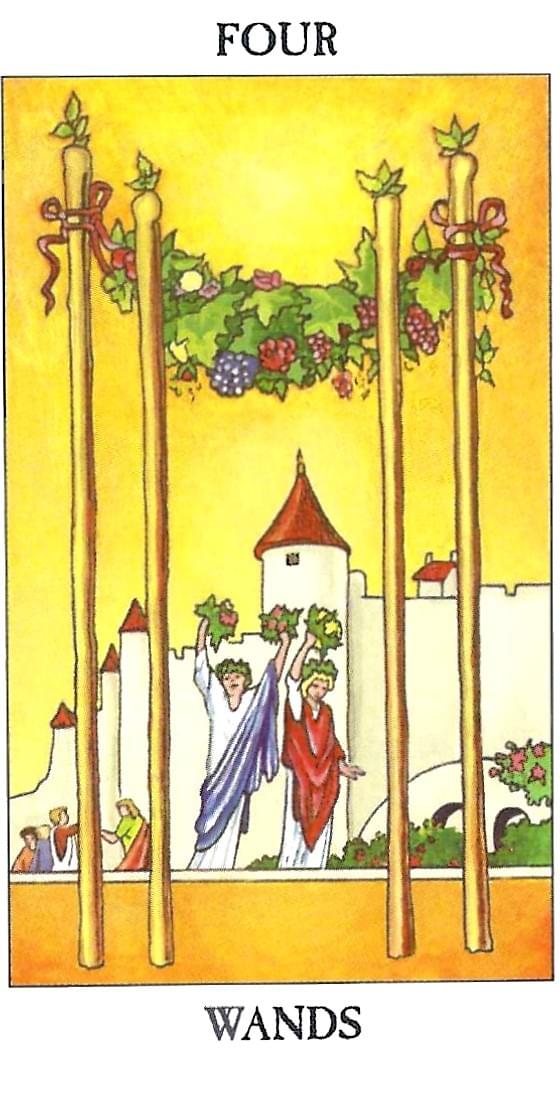
The arbor itself functions as a threshold symbol. Unlike a closed fortress or sealed enclosure, this structure is open on all sides. It marks a place of passage rather than confinement. In Hermetic terms, this suggests stability without rigidity—strength that does not fear openness. One is secure enough to welcome others in.
The grapevine deepens this meaning further. Grapes have long been associated with fertility, sacred intoxication, and transformation. Alchemically, they point toward fermentation—the mystery by which raw matter becomes spirit-infused substance. Mystically, grapes evoke the Dionysian current: joy, ecstasy, and the sanctification of life through celebration. Thus, the happiness indicated by this card is not superficial pleasure but a consecrated joy, a moment where life itself is affirmed as sacred.
The figures beneath the arbor reinforce this idea of unity and homecoming. They suggest reunion, shared triumph, and communal recognition. This may manifest as family gatherings, weddings, successful collaborations, or a return to a place—or state of being—where one truly belongs.
Spiritually, the arbor may be understood as a temporary temple, a space where the mundane and the sacred meet. The celebration is not merely social; it is initiatory. The card marks a moment of alignment where outer success mirrors inner harmony.
Finally, the Four of Wands also acts as a gateway to a new phase. Passing beneath the arbor symbolizes transition—moving forward with the assurance that the foundation is sound and the path ahead is blessed. It is the pause between effort and the next expansion, a breath taken in gratitude before the next movement of Will.
Overall, the Rider-Waite-Smith Four of Wands portrays a moment of balanced fire: power stabilized, joy shared, and abundance acknowledged. It reminds us that true strength is not proven by isolation, but by the ability to create spaces where others may gather, rejoice, and be renewed.
The Triple Goddess Tarot – Four of Wands
Celebration of the Accomplished Will
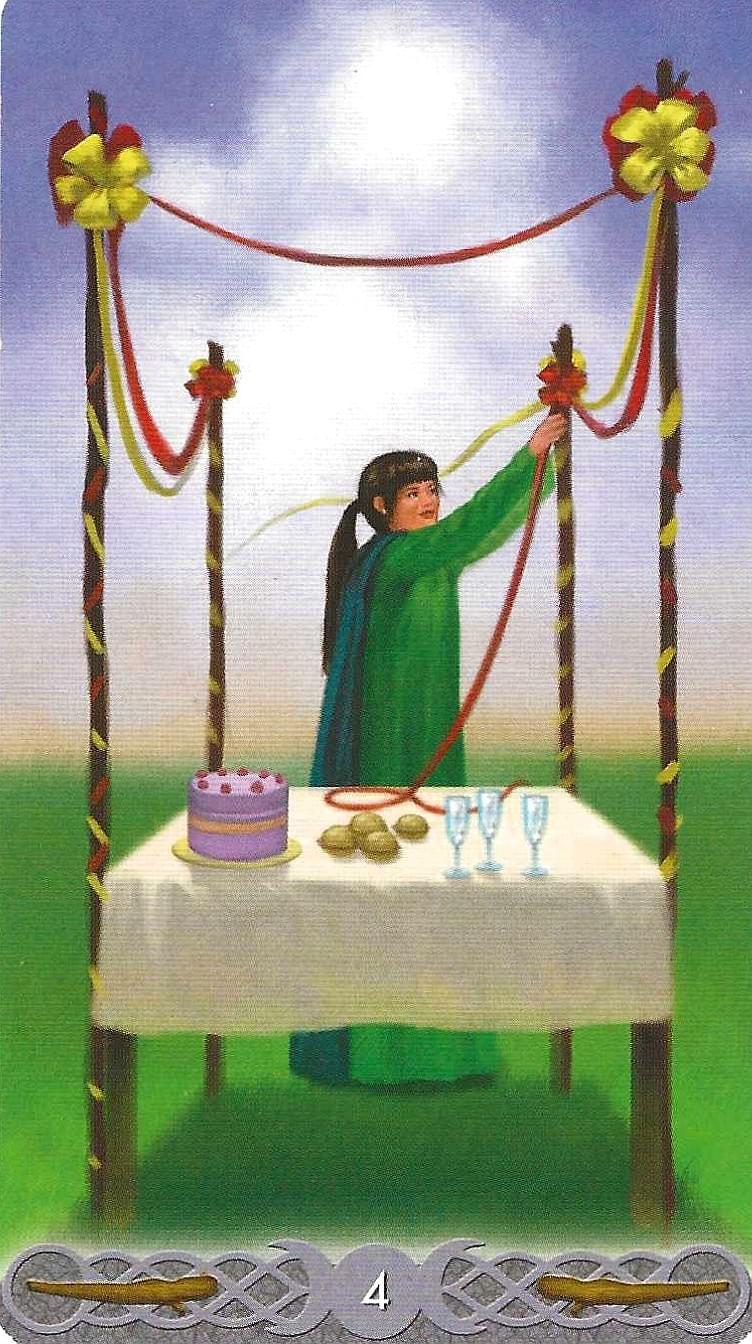
In the Triple Goddess Tarot, the Four of Wands presents a strikingly intimate variation on the traditional theme of celebration and completion. Rather than a communal gathering, we are shown a single Maiden carefully decorating four upright wands with red and gold ribbons and bows. These wands enclose a table laden with cake, cookies, and three wine glasses—clear emblems of festivity, nourishment, and consecrated joy. (The Wine glasses are for the maid, mother, and crone of the Triple Goddess.)
The Maiden is dressed in a long green robe, harmonizing perfectly with the green grass lawn upon which the celebration is set. Green here is not incidental; it is the color of life, fertility, and sustained growth. This signals that the Will (Fire/Wands) has not merely flared and burned but has rooted itself into living continuity. Fire has married Earth, producing stability without stagnation.
Although only one figure appears, this card does not imply isolation. Rather, it emphasizes conscious acknowledgment. The Maiden acts as both celebrant and officiant, suggesting that there are moments when the practitioner must pause, recognize, and sanctify their own achievements before inviting others to partake. The three wine glasses subtly indicate presence-in-absence—the work has been completed with others in mind, even if the final act of recognition is solitary.
The enclosed space formed by the four wands echoes the archetypal function of all Tarot Fours. Across the Minor Arcana, the number four signifies perfection, realization, completion, and fixation of force into form. The matter is no longer fluid; it has been settled, stabilized, and made secure. This is the point at which effort ceases and structure holds.
In the suit of Wands, this stabilization pertains specifically to Will. Aleister Crowley aptly titled this card The Lord of Perfected Work, describing it as the stage where “a matter is settled.” The creative fire has accomplished its task. The vision has been enacted. What was once an impulse or intention has now become an established reality.
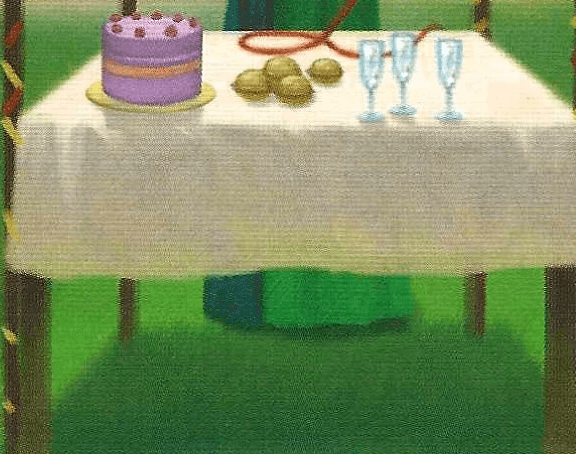
The table of sweets and wine elevates the meaning beyond mere success. This is ritual celebration, not indulgence. Cake and cookies represent reward and sweetness earned through labor; wine represents spiritual intoxication—the sacred joy that arises when Will aligns with purpose. In this sense, the Four of Wands becomes a quiet rite of thanksgiving, an acknowledgment that creation itself is holy.
While teamwork, community, and shared success are implicit, the Triple Goddess Tarot places emphasis on personal sovereignty within completion. The Maiden reminds us that no work is truly finished until it is consciously honored. Celebration is not frivolous—it is the sealing of the Work.
Thus, this card teaches a crucial Hermetic lesson:
Before moving on to the next act of Will, one must stand within the completed circle, recognize the harmony achieved, and allow joy to consecrate the foundation laid.
Only then is the Work truly perfected


As for the Rider-Waite-Smith 4 of Wands, the implied meanings are easily seen on the Cards imagery. The castle behind the couple on the card imply security and those outside the walls are at some risk as they seek an order without walls, to freely enjoy the fruits of one's labors.
If you have questions just ask Eli's Thoth Tarot Guide for concise answers.
When the 4 of Wands card is thrown in a divination, it implies:
- Country life.
- Repose.
- Concord.
- Harmony.
- Prosperity.
- Peace.
- The perfected work of the above.
- Perfection, realization, completion, and making a matter settled and fixed.
- Pride in your accomplishments.
- Celebrating life.
When the Four/4 of wands is reversed:
- The meanings remain unaltered:
- Increase.
- Felicity.
- Beauty.
- Embellishment.
Thank you for your interest, comments, and supportive donations. May you live long and prosper.
3 Western Hermetic Tarot and Magick Websites Helping People become more Magic and Less Tragic since 2010.
Traditional Tarot Card Comparisons and layout store.
For information of personal online tarot readings and/or Master Western Hermetic Tarot classes, and nontraditional Tarot Card Comparisons Blog, just click on the elitarotstrickingly.com button and then click on the Tarot-Store tag for class or blog for Hermetic Tarot. Thank you.
Western Hermetic magick ritual and invocation website and magick blogs.
