
elitarot2strikingly.com
Above all things, know thyself.
[Rider-Waite-Smith (RWS) Tarot cards and decks plus Tarot Book sold in webstore]
The Radiant Rider-Waite-Smith Tarot- Key 1-The Magician
The Wyspell Tarot – Key 1: The Magician & Rider–Waite–Smith Tarot – Key 1: The Magician
The House of Divine Will: Mercury, Beth, and the Art of Making Spirit Manifest
Western Hermetic Qabalah | Metaphysics | Parapsychology | Astrology | Numerology | Alchemy | Cosmology | Theology
The Magician: That Which Builds the House
The Magician, known as the Magus in the Thoth Tarot, represents the awakening of conscious Will and the ability to direct the invisible forces of Mind into visible manifestation. He is the Divine Messenger, the architect of thought, and the conscious instrument through which Spirit begins to express itself as form.
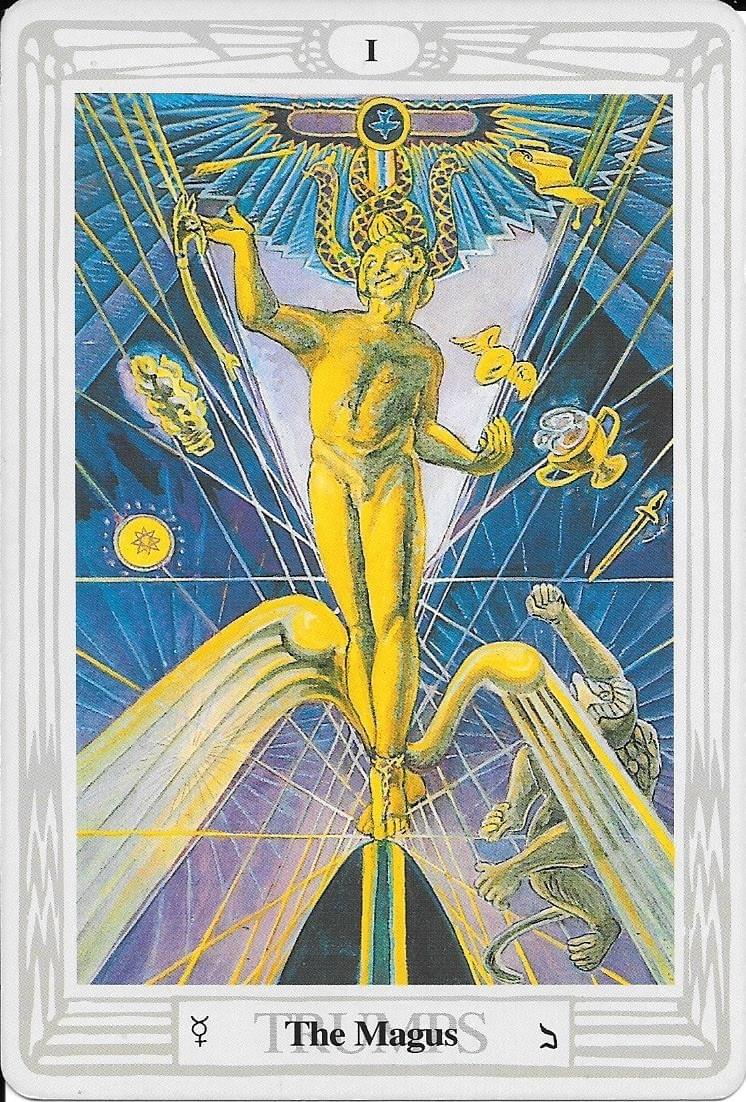
To understand the esoteric symbolism shared by the Wyspell and Rider–Waite–Smith Magicians, we shall briefly consult the Thoth Magus, whose Western Hermetic correspondences are especially explicit.
In the Hermetic Order of the Golden Dawn system, the Magician is assigned:
Hebrew Letter: Beth (ב), meaning House
Tree of Life: Path 12, connecting Kether (Crown) to Binah (Understanding)
Planetary Attribution: Mercury
Tarot Number: 1 — Concentration, initiation, and directed Will
Magickal Function: Translating spiritual potential into intelligent, creative activity
These correspondences establish the Magician as the mediating intelligence between the limitless potential of Kether and the organizing, form-giving power of Binah.
Beth: The Womb-Temple of Manifestation
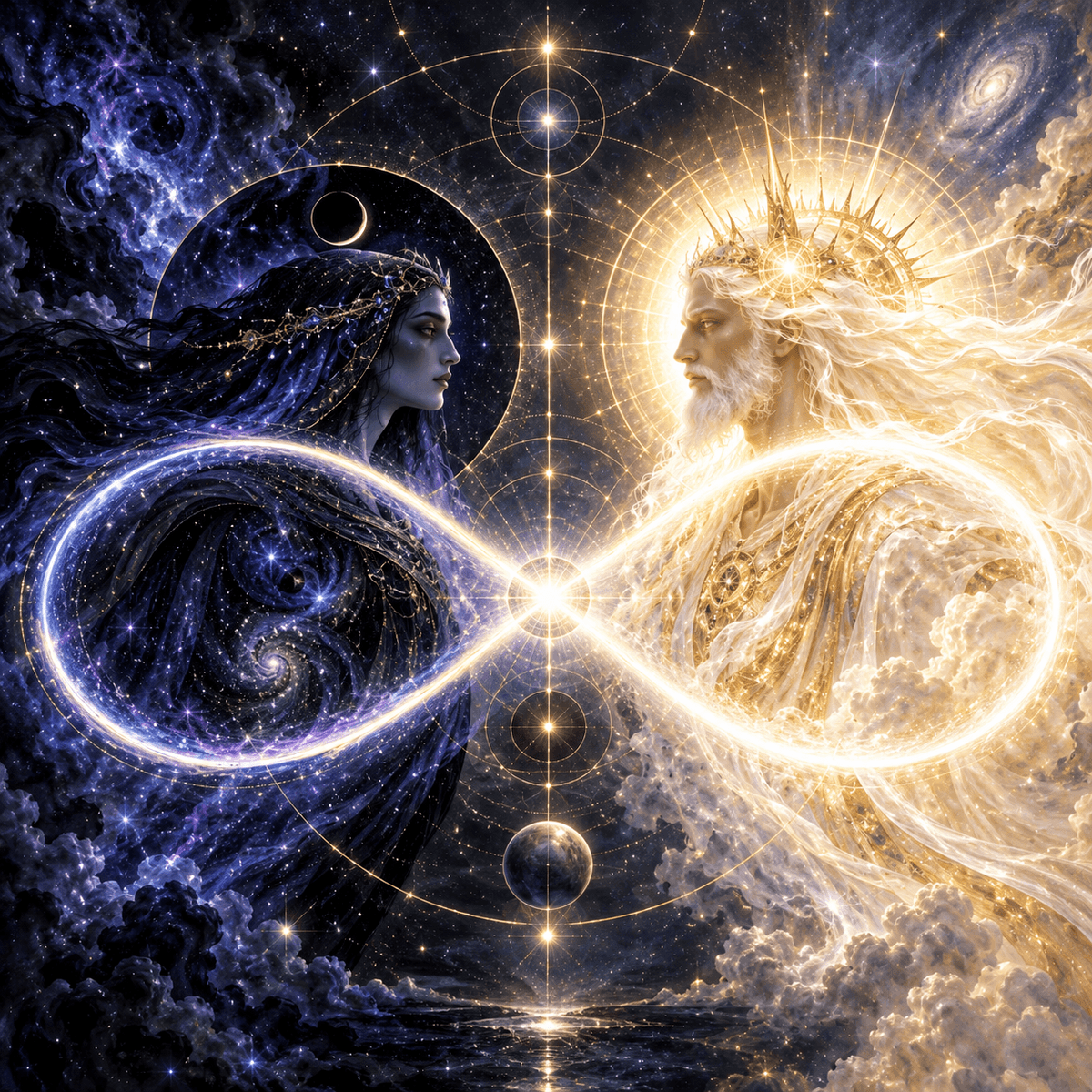
The Hebrew letter Beth, meaning House, symbolizes the dwelling place of Spirit: the sacred enclosure wherein the limitless becomes defined.
Kether is the Crown, the first emanation of Divine Being. Its Divine Name, Eheieh, is commonly translated as "I Am" or "I Will Be." This is the primal declaration of existence before individual identity becomes differentiated.

Binah, the Third Sephirah, is the Great Mother, the Supernal Understanding that receives creative impulse and establishes its boundaries.
Between them travels Beth, the Mercurial Path of the Magus.
In symbolic terms, Kether declares, "I Will Be"; the Magus communicates that Will; and Binah answers, "Then let there be a form in which Being may dwell."
The Magus is therefore that which builds the House—the principle that directs the primal Life Force toward intelligent expression.
Mercury does not create the Divine Will. He communicates and articulates it. He is the messenger, translator, and magician of correspondence.
After all, even the gods require reliable communication. Fortunately, Mercury operates without a monthly subscription!
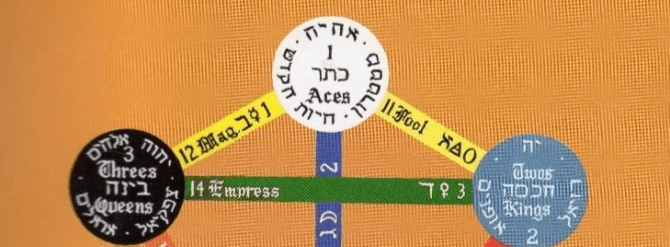
The Supernal Triangle: Three Expressions of One Divine Will
The Magus/Magician cannot be properly understood without examining the relationship between Kether, Chokmah, and Binah.
These three Supernal Sephiroth form the highest triangle upon the Qabalistic Tree of Life:
Sephirah | Creative principle |
|---|---|
Kether — Crown | Pure Being; the primal Will-to-Be |
Chokmah — Wisdom | Dynamic Will-to-Force; archetypal Father |
Binah — Understanding | Receptive Will-to-Form; archetypal Mother |
Three Tarot paths connect these Supernals:
Tarot ATU | Hebrew letter | Connection |
|---|---|---|
ATU 0 — The Fool | Aleph, Air | Kether ↔ Chokmah |
ATU I — The Magus | Beth, Mercury | Kether ↔ Binah |
ATU III — The Empress | Daleth, Venus | Chokmah ↔ Binah |
The Fool represents the free movement of Spirit, the Magus its intelligent articulation, and the Empress the fertile relationship through which Force becomes Form.
These are not three independent creators but three distinguishable activities of one Divine Reality.
In Hermetic metaphysics, their apparent separation is conceptual rather than physical. The Father, Mother, and emerging Creation are inseparable expressions of one cosmic process.
Thus, the Supernal Triangle may be contemplated as a Trinity of Will: Will-to-Be, Will-to-Force, and Will-to-Form.
The One Great Being is not a giant human sitting upon a celestial throne. Such anthropomorphic imagery is symbolism, not anatomy. To a Hermetic Qabalist, Divine Being represents an eternal principle of consciousness and intelligence beyond human personality.
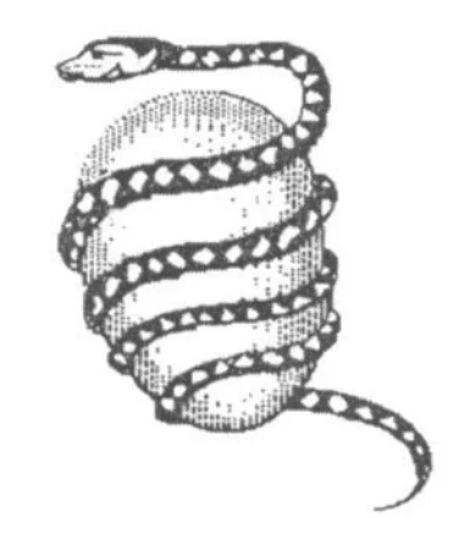
The Cosmic Egg: Akasha, the Serpent, and the Birth of Creation
The winged egg associated with the Thoth Magus invites comparison with the Cosmic Egg, the Orphic Egg, and the Akashic seed of universal manifestation.
In Orphic cosmology, the primordial egg symbolizes the emergence of cosmic life and the generative power from which creation unfolds.
Within a Hermetic interpretation, this egg becomes the image of undifferentiated possibility awaiting awakening through Divine Will.
The serpent entwined around the Cosmic Egg adds several layers of meaning.
Union of the masculine and feminine. The serpent can represent the penetrating, activating principle of Force, while the egg represents the receptive womb of potentiality. Their union symbolizes the alchemical marriage of complementary creative energies.
The eternal cycle of manifestation. Through comparison with the Ouroboros, the self-encircling serpent becomes an emblem of cyclic existence: generation, dissolution, and regeneration.
The containment of primordial power. The egg encloses possibility before manifestation. Binah, the Supernal Mother, provides an analogous boundary wherein the unlimited is prepared for definition.
The awakening of consciousness. In a comparative interpretation drawing upon Kundalini symbolism, the serpent may represent latent spiritual energy awaiting conscious activation. This is a modern esoteric parallel, rather than an assertion that the ancient Orphics taught the later chakra system.
The Cosmic Egg expresses a fundamental Hermetic principle: Creation is not merely the production of something from nothing, but the emergence of differentiation within an undivided potential.
The egg is possibility. The serpent is activation. The Magus is the intelligence that gives the creative impulse direction.
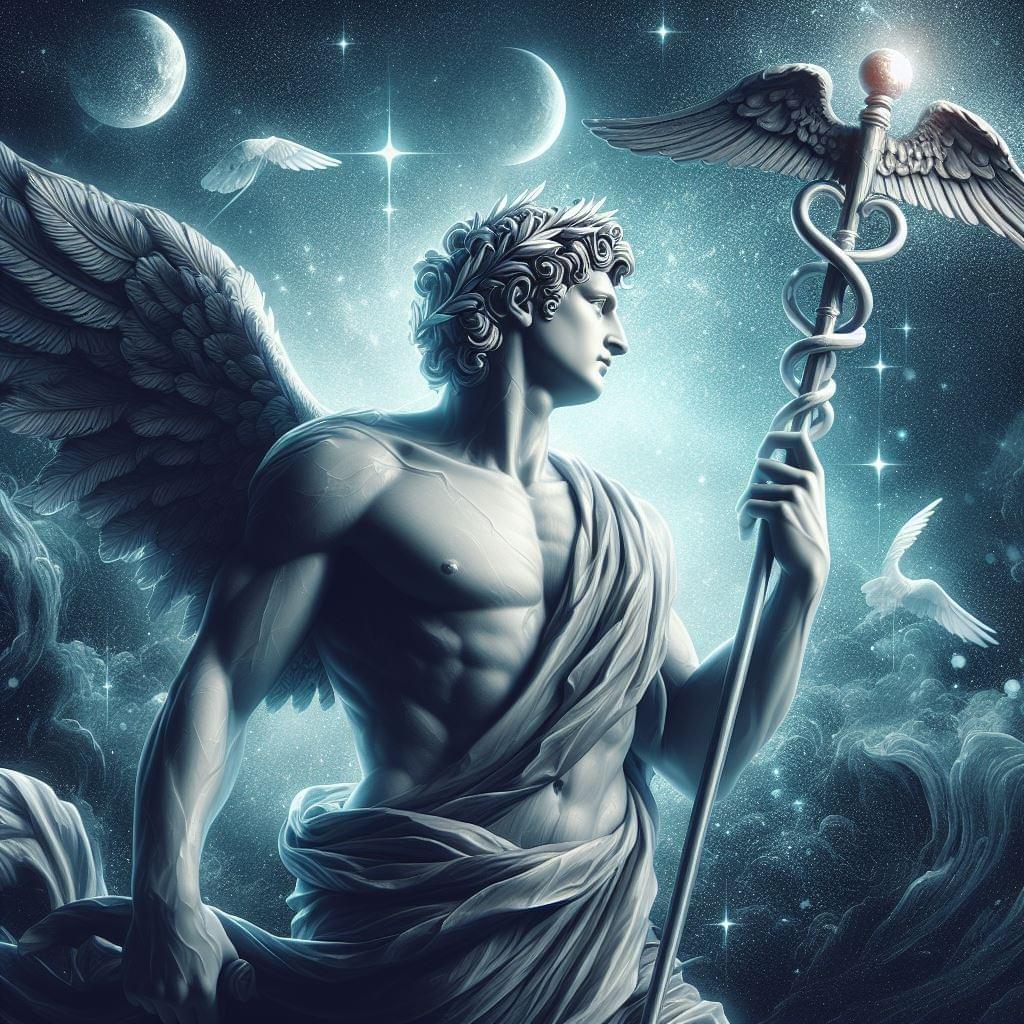
Mercury: The Divine Messenger and Architect of Thought
Astrologically, the Magician corresponds to Mercury, the planet of intellect, language, analysis, exchange, and communication.
Mercury translates thought into language, intention into instruction, and knowledge into practical action.
In classical mythology, Hermes moves between divine and mortal realms. In Western Hermetic philosophy, this becomes a metaphor for the movement of consciousness between higher principles and earthly experience.
The Magician's raised wand and earthward-pointing hand declare the Hermetic axiom:
As above, so below.
However, successful magick requires more than wishing, chanting, or waving an expensive wand.
It requires intention, imagination, concentration, knowledge, and effective action.
A mind without focus is merely an untrained Mercury running around delivering messages to the wrong planets!

The Four Worlds of Creative Expression
The Magician's work can also be interpreted through the Four Qabalistic Worlds:
World | Expression of the Magician's Will |
|---|---|
Atziluth — Emanation | The original spiritual impulse |
Briah — Creation | The archetypal conception |
Yetzirah — Formation | The mental and imaginal pattern |
Assiah — Action | The physical execution and manifestation |
The magician begins with an intention, organizes it through imagination and understanding, and acts upon it in the physical world.
This does not mean that thought alone guarantees material results. Rather, consciousness, decision-making, and disciplined action help shape the circumstances through which possibilities become realities.
The Magus/Magician must do more than think magickally. The Magus/Magician must act intelligently.
Numerology: Number One and the Point of Concentration
The Magician bears the number 1, symbolizing unity, initiative, individuality, and concentrated creative Will.
In sacred geometry, the point is the beginning of a defined position. It has no physical dimension, yet serves as the conceptual origin from which lines, planes, and forms can be constructed.
Thus, the number One represents the focusing of potential into intention.
In spiritual initiation, the aspirant must learn to direct awareness rather than remain enslaved to every passing thought, emotion, or social suggestion.
The true Magician understands that attention is a resource. Wherever attention is repeatedly invested, habits and patterns of consciousness develop.
This is why mental concentration is among the first disciplines of the Great Work.
Without concentration, the aspirant is little more than a wand-wielding squirrel distracted by every shiny acorn.
The Lemniscate and Crowley's Formula: 0 = 2
Both the Wyspell and Rider–Waite–Smith Magicians display the lemniscate, the horizontal figure-eight symbol of infinity, above the practitioner's head.
This emblem represents inexhaustible potential, continuity, and the dynamic reconciliation of apparent opposites.
It may also be contemplated alongside Aleister Crowley's metaphysical formula:
0 = 2
This is not an ordinary arithmetic equation. It is a symbolic statement concerning the relationship between Nothingness and manifestation.
In Thelemic metaphysics, the undifferentiated Zero gives rise to apparent polarity, while the complementary opposites remain inseparable expressions of the original totality.
The formula suggests that duality is not ultimately alien to unity.
In alchemical language, it is the interaction of opposites that makes transformation possible.
The masculine and feminine, active and receptive, expansion and contraction, solve and coagula, are understood as complementary cosmic operations.
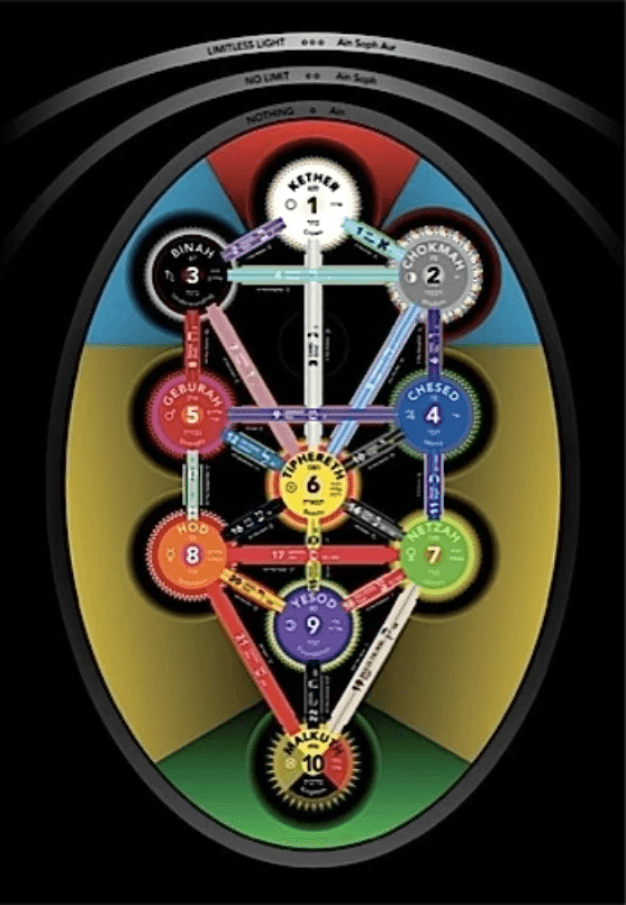
Importantly, Zero should not be confused with Chokmah simply because Chokmah bears the number Two. The Qabalistic Veils of Negative Existence, including Ain and Ain Soph, precede the numbered Sephiroth. Crowley's formula addresses a metaphysical relationship that cannot be reduced to one numerical attribution upon the Tree.
The Magician is the operative intelligence capable of reconciling polarities within consciousness and using their interaction creatively.
The initiate learns that apparent opposites are not necessarily enemies. They may be two hands belonging to one cosmic worker.
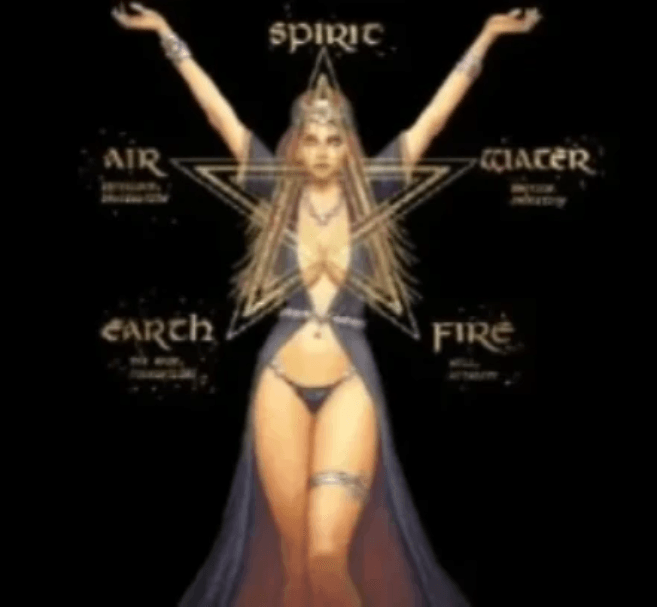
The Human Body: The Living Altar of Magick
In the Rider–Waite–Smith and Wyspell decks, the Magician stands before a table containing the four elemental instruments.
The Thoth Magus, by contrast, emphasizes the living, dynamic body of the magician as the center of the operation.
This distinction reveals a profound Hermetic lesson: the human being is not separate from the magickal instruments. The human being is the living microcosm in which their principles converge.
The four implements represent:
Instrument | Element | Human expression |
|---|---|---|
Wand | Fire | Will, vitality, creative impulse |
Cup | Water | Emotion, receptivity, intuition |
Sword | Air | Thought, analysis, communication |
Disk/Pentacle | Earth | Body, practical action, material existence |
When these four elemental principles are harmonized, the aspirant becomes an effective instrument of directed consciousness.
In the symbolism of YHVH, the four letters represent the progressive articulation of creative power. The Magician learns to coordinate these forces rather than allow any one element to dominate.
The Wand without the Cup becomes reckless ambition. The Sword without the Cup becomes cold intellectualism. The Cup without the Sword may become emotional confusion. Earth without Fire can become inertia.
The Great Work involves their intelligent cooperation.
The body is therefore not an obstacle to initiation but an essential instrument of it.
The living Temple is already equipped with the necessary tools. The challenge is learning how to operate them.
The Magician and the Extraordinary Human Senses
The body also possesses a remarkable network of sensory systems through which consciousness receives information.
Traditional education commonly identifies five senses: sight, hearing, smell, taste, and touch. However, contemporary physiology distinguishes many additional sensory processes.
These include:
Proprioception: Awareness of the body's position and movement.
Interoception: Perception of internal physiological conditions.
Equilibrioception: Balance and orientation.
Thermoception: Temperature perception.
Nociception: Detection of potentially damaging stimuli.
Chronoception: The experience of time.
Mechanoreception: Detection of touch, pressure, vibration, and mechanical forces.
Some classifications identify dozens of sensory modalities, but there is no universally accepted scientific count of exactly 33 human senses, although Tantra yoga claims them.
Certain animals possess additional specialized capacities. Foxes, for example, have been studied for possible use of Earth's magnetic field when orienting their hunting pounces, though the underlying mechanism remains uncertain.
Human magnetoreception is also an intriguing research question, but conscious human magnetic navigation has not been established.
From a parapsychological perspective, these discoveries invite questions about the relationship between conscious perception, unconscious processing, and experiences interpreted as intuitive or extrasensory.
Nevertheless, ordinary sensory capabilities should be distinguished from claims of telepathy or clairvoyance, which have not been established as reliable scientific phenomena.
The Hermetic lesson remains valuable: The conscious personality knows far less about the body's ongoing intelligence than it often assumes.
The Magician seeks greater awareness of this living instrument through observation, training, contemplation, and disciplined practice.
The Rider–Waite–Smith Magician: The Conscious Director of Force
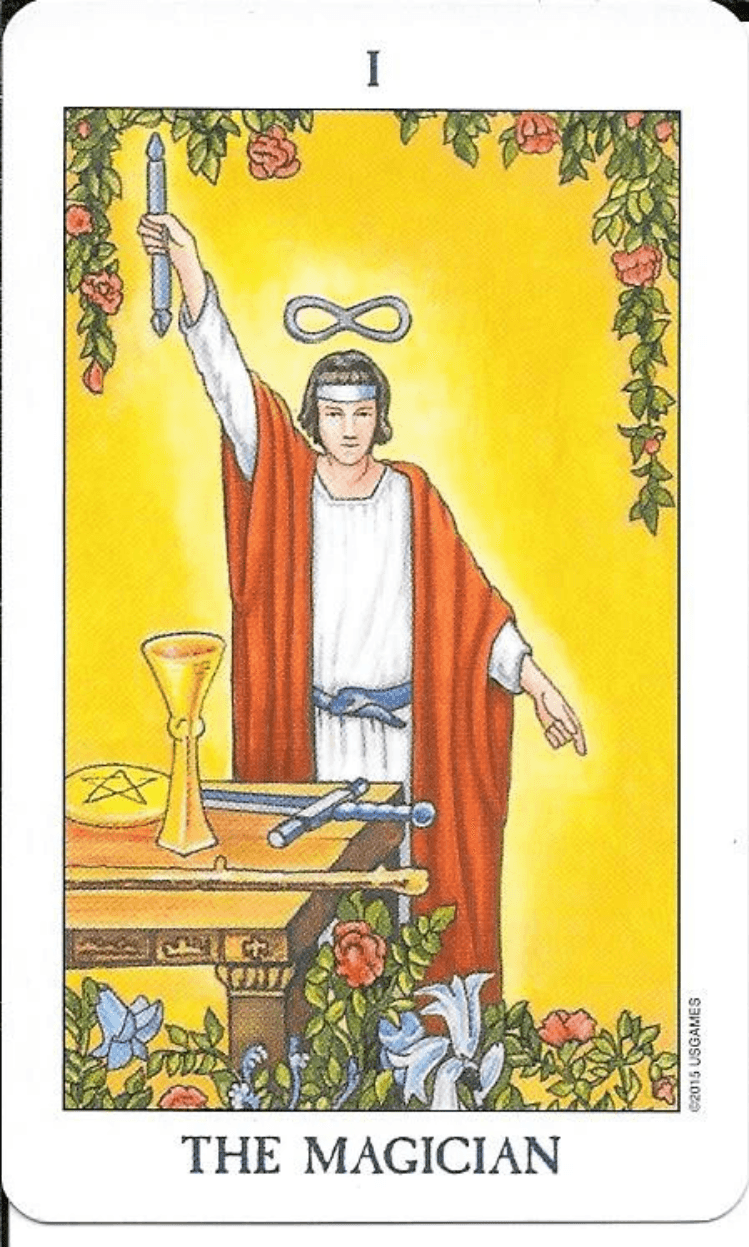
The Rider–Waite–Smith Magician stands before an altar holding the four implements of elemental magick: Wand, Cup, Sword, and Pentacle.
One arm is extended heavenward, while the other points toward Earth.
This gesture expresses the transmission of higher Will into practical earthly activity.
Above the Magician's head floats the lemniscate, while the serpent encircling his waist symbolizes continuity, cyclic regeneration, and self-renewing Life Force.
The red roses suggest desire, vitality, and creative passion, while the white lilies symbolize purification and the refinement of consciousness.
The Magician's red outer robe and white undergarment further emphasize the cooperation of active energy and purified intention.
He does not merely possess the four tools; he commands their appropriate use.
This is the central distinction between an ordinary personality driven by circumstances and an initiated consciousness capable of directing its attention and actions.
The Magician is not simply someone who knows things.
The Magician is someone who knows how to use what is known.
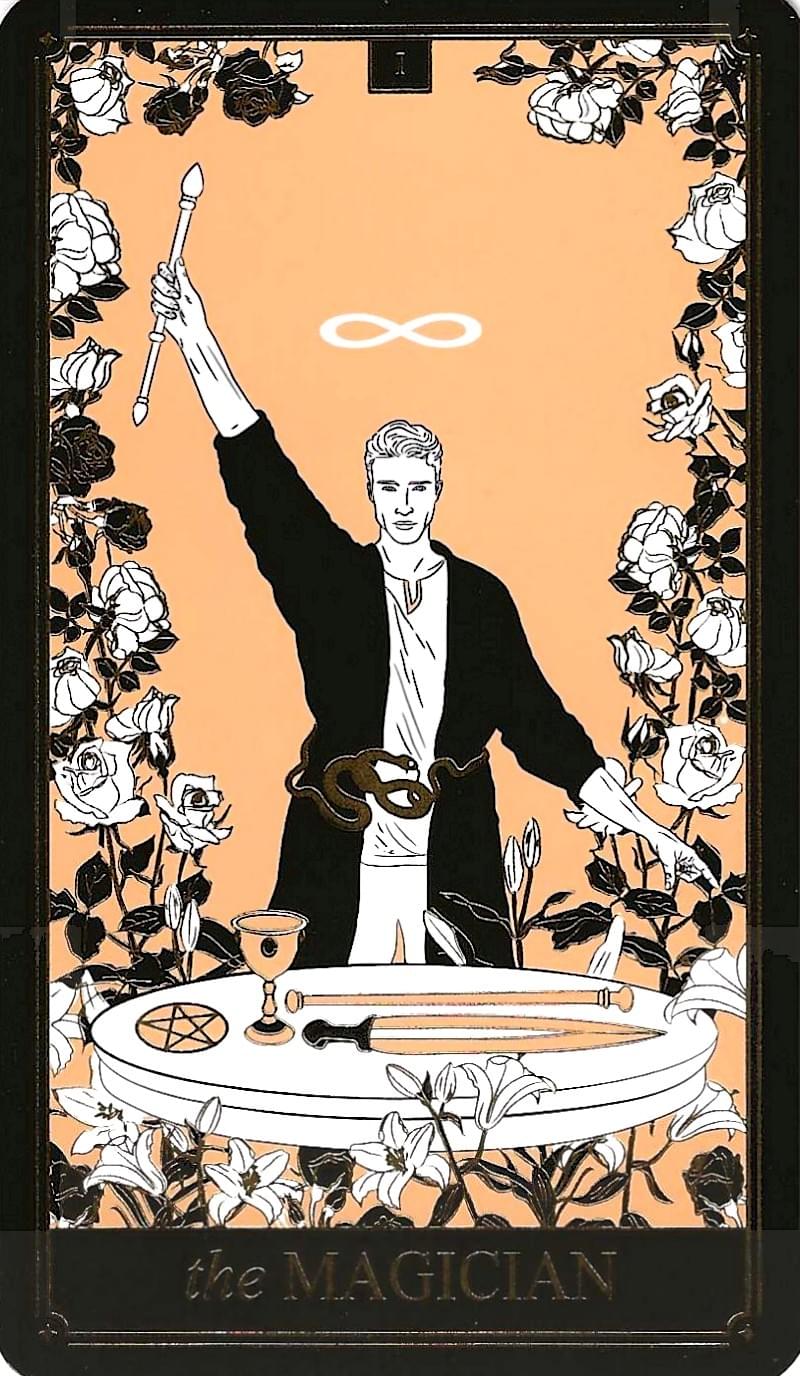
The Wyspell Tarot - Key 1-The Magician
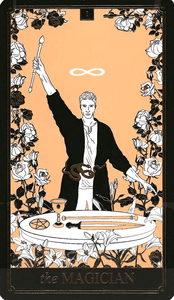
The Wyspell Tarot — Key 1: The Magician
The Wyspell Tarot presents an interpretation closely related to the familiar Rider–Waite–Smith composition, while employing its own artistic coloration and atmosphere.
Above the Magician's head appears the horizontal figure-eight lemniscate, representing continuity and the limitless potential of consciousness.
His right hand raises the Wand toward heaven, while his left points toward Earth, reaffirming the Hermetic doctrine of correspondence.
A serpent belt encircles his waist, symbolizing the regenerative Life Force and the cyclic nature of creation.
The white roses surrounding him suggest spiritual refinement and the purification of desire. The white lilies blooming before the altar likewise symbolize the possibility of transforming raw instinct into conscious spiritual development.
Upon the altar rest the Pentagram, Cup, Sword, and Scepter—representing Earth, Water, Air, and Fire.
The altar itself symbolizes manifested existence, the stable foundation upon which the elements are organized into effective action.
Where the RWS Magician presents the classical initiatory image, the Wyspell Magician invites the reader to recognize that the very same powers are available within the human microcosm.
Neither card instructs us to wait passively for destiny to arrive.
Rather, both declare:
You possess the instruments. You possess the potential. Now develop the skill and courage to use them.
The appearance of this card may signal the beginning of a new career, business venture, relationship, intellectual project, or spiritual initiation.
Its central message is not that success will arrive without effort, but that the necessary potential exists for purposeful action.
The Magician does not wait for opportunity to knock. He learns how to build the door!
Theological and Cosmological Meaning: The Word Made Manifest
In comparative theology, the Magician may also be examined through the creative power of the Logos, the Divine Word.
The opening of Genesis presents creation through divine speech, while the Gospel of John places the Logos at the beginning of its theological vision.
These traditions are not identical, but Hermetic interpretation recognizes a shared symbolic concern: the relationship between intelligence, expression, and the emergence of an ordered cosmos.
The Magus/Magician, as Mercury, becomes the archetype of articulation—the transformation of intention into intelligible expression.
Human language likewise affects the way experience is interpreted, relationships are formed, and actions are organized.
Words are not automatically supernatural commands capable of changing external reality. Yet they can shape belief, intention, emotional response, and behavior.
Therefore, the aspiring Magician learns to speak with discrimination.
A careless tongue may create unnecessary conflict; a disciplined one may organize cooperation, understanding, and constructive action.
Here we discover one of the practical mysteries of Mercury:
Speech is not merely the expression of thought. It is one of the instruments through which human beings organize their world.
And that is why the Magus/Magician must occasionally learn the most difficult spell in the entire grimoire: silence.
Divination: When the Magician/Magus Appears
When the Magician appears in a reading, the emphasis is upon concentrated Will, personal initiative, developed ability, and the intelligent use of available resources.
It is a card of self-realization through purposeful activity.
Upright or Well-Dignified
Assertiveness and self-confidence.
Self-realization and developing mastery.
Strength of Will and mental concentration.
Vital energy, initiative, and determination.
Creative problem-solving and communication.
Greater awareness of unconscious habits and motivations.
The beginning of a career, enterprise, relationship, or creative endeavor.
Bringing ideas, dreams, and spiritual aspirations into practical reality.
Recognizing one's own talents and learning to use them responsibly.
The card frequently announces that the querent has more ability than they have yet demonstrated.
The time has come to exchange endless preparation for intelligent action.
Reversed or Ill-Dignified
In traditions employing reversals, or when the Magician is ill-dignified by surrounding cards, its qualities may become distorted.
Egotism and exaggerated self-importance.
Manipulation or deception.
Misuse of knowledge, influence, or authority.
Aggressiveness and impulsiveness.
Scattered attention and wasted energy.
Intellectual arrogance or self-deception.
Lack of discipline or direction.
Confusion between genuine ability and theatrical appearances.
Unethical persuasion or the deliberate exploitation of others.
The shadow Magician is not necessarily weak. Indeed, this figure may possess considerable talent but direct that talent toward illusion rather than understanding.
When poorly dignified, the card asks whether Will is being guided by wisdom or by an insecure personality seeking control.
The magician's greatest danger is believing that mastery over appearances equals mastery over Self.
The Final Hermetic Lesson: Above All Things, Know Thyself
The Magician is the first numbered ATU because the journey toward spiritual mastery requires the awakening of conscious participation.
The Fool moves in the freedom of primordial Spirit. The Magician learns to direct that energy with purpose.
He is Mercury, the messenger; Beth, the House; and Number One, the concentrated point of creative intention.
Within Western Hermetic Qabalah, the Magus is not merely a figure performing external wonders. He symbolizes the conscious intelligence that learns to reconcile the Four Elements within the living Temple of the human being.
His initiation begins when the personality stops identifying itself entirely with its passing thoughts, emotions, and social conditioning and begins examining the deeper principles through which experience is organized.
Through concentration, knowledge, ethical Will, and purposeful action, the aspirant seeks to transform unconscious reaction into conscious participation in life.
For the Great Work is not accomplished by merely imagining oneself to be a Magus.
One must learn to live accordingly.
Above all things, know thyself.
And remember: the Wand is marvelous, the Sword is sharp, the Cup is deep, and the Disk is practical—but none of them will wash your dishes, pay your bills, or perform your Great Work without your participation!

Thank you for your interest, thoughtful comments, and supportive donations. Your encouragement helps keep the wisdom of Western Hermetic Qabalah and Tarot available to fellow seekers. May your Will be clear, your path illuminated, and your life more magick and less tragic. Live long and prosper!
3 Western Hermetic Tarot and Magick websites helping people become more magic and less tragic since 2010.
Traditional Tarot Card Comparisons Blog and Tarot card and bookstore.
Home page, Tarot store, Master Tarot Classes, Tarot decks, bookstore, and Nontraditional Tarot Card Comparisons blog.
Western Hermetic magick invocation and ritual website plus magick blogs.