
elitarot2strikingly.com
Above all things know thyself.
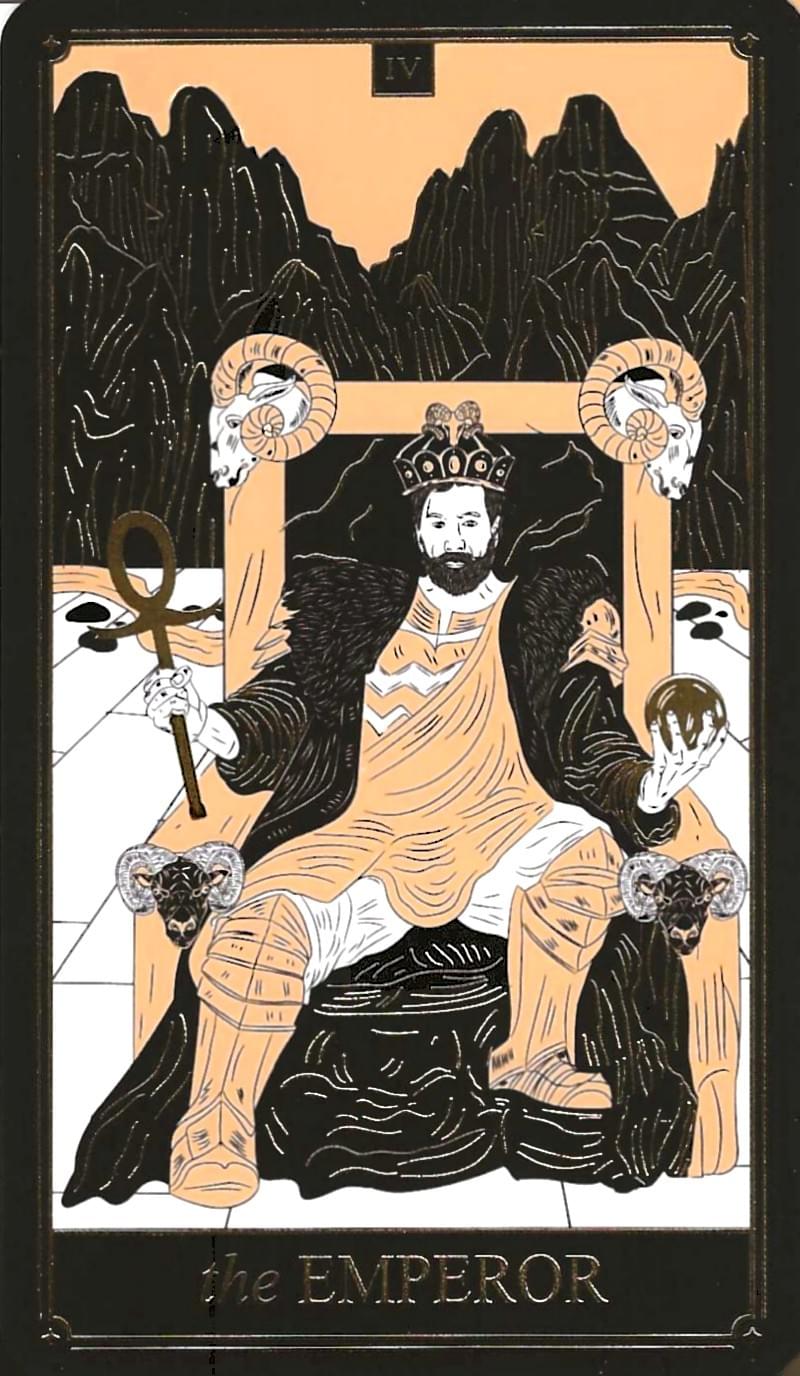
The Wyspell Tarot-The Emperor-Key 4
He who blinded by ambition, raises himself to a position whence he cannot mount higher, must thereafter fall with the greatest loss.
-Niccolo Machiavelli
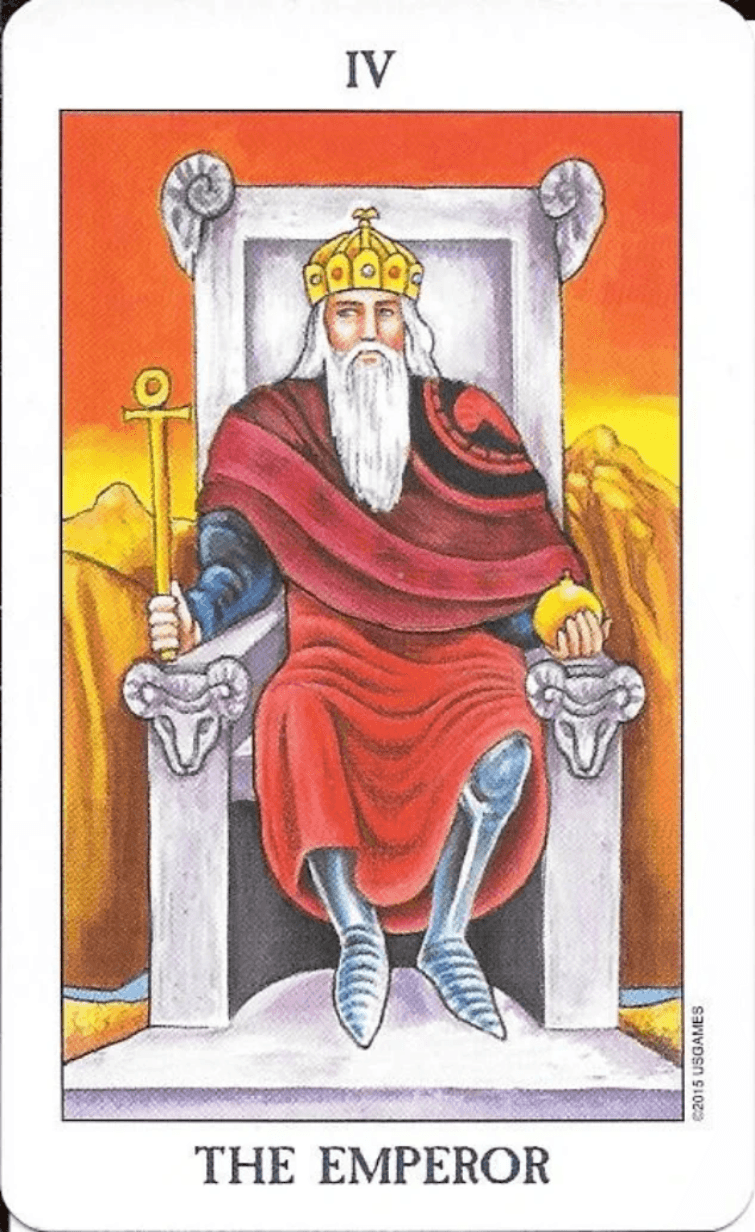
The Rider-Waite-Smith (RWS) Tarot- Key 4-The Emperor
[RWS Tarot card and Tarot books are sold in my webstore]
The Wyspell Tarot — Key 4, The Emperor & Rider–Waite–Smith Tarot — Key Four, The Emperor
The Constituting Intelligence: Divine Authority, the Solar Logos, and the Architecture of Consciousness
SEO Meta Description:
Explore the Wyspell and Rider–Waite–Smith Emperor through Western Hermetic Qabalah, Aries, sacred authority, the Solar Logos, and the 15th Path of Heh.
The Emperor — The Divine Architect of Consciousness
The Emperor, Key 4, represents the power of Divine Will to establish order, create boundaries, and transform the limitless possibilities of consciousness into organized expression.
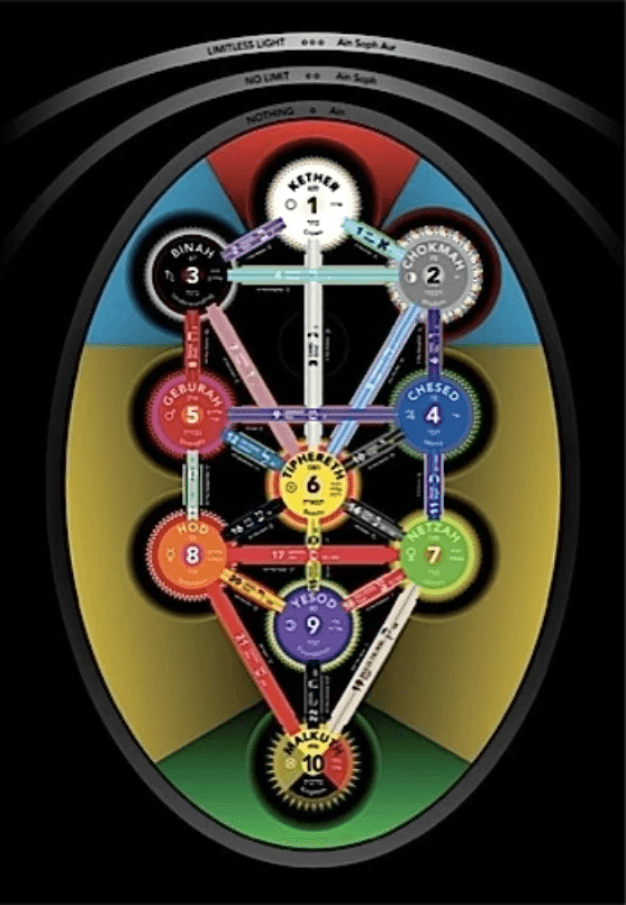
In Western Hermetic Qabalah, the Emperor is traditionally assigned to the 15th Path of Heh (ה), connecting the second Sephirah, Chokmah (Wisdom), to the sixth Sephirah, Tiphareth (Beauty), the Solar Logos.
Paul Foster Case identifies this path as the Constituting Intelligence, an attribution explored in his writings on the Thirty-Two Paths of Wisdom.
But what does that mean?
Simply put, the Emperor is the intelligence that establishes the architecture through which consciousness becomes an ordered experience.
If the Empress is the Creatrix who gives birth to possibilities, the Emperor is the Architect who measures, defines, and organizes those possibilities into functioning expressions of life.
The Empress says, "Let there be life." The Emperor replies, "Excellent! Now, where are we going to put it, and who is paying the electric bill?"
Even Divine Creation benefits from a little organization!
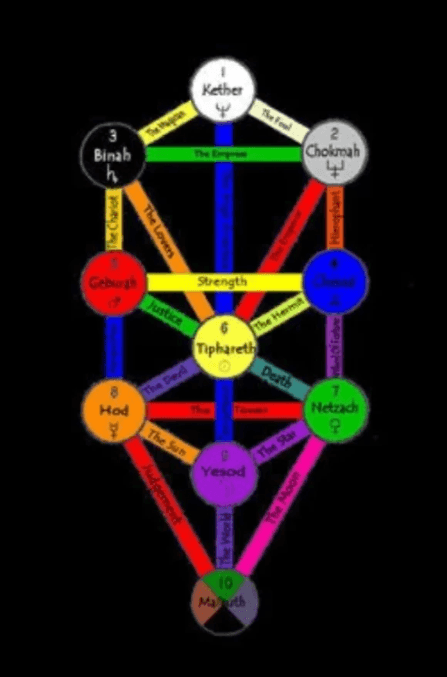
The Constituting Intelligence: The 15th Path of Heh
The Hebrew letter Heh means "window." It symbolizes an opening through which consciousness perceives, defines, and gives recognizable expression to the invisible.
The 15th Path connects two extraordinary states of consciousness:
Chokmah — Wisdom: The Supernal Father, the primordial dynamic force of creation, and the first expression of polarized Divine Will.
Tiphareth — Beauty: The Solar Logos, the harmonizing center of the Tree of Life, and the radiant consciousness of the Higher Self.
The Emperor establishes a relationship between these two principles.
Chokmah provides the original impulse of Will; Tiphareth becomes the radiant center through which that Will can be experienced as individual Soul-consciousness.
The Emperor is the organizing principle between them.
Thus, he establishes the metaphysical relationship between "I Will" and "I Am."
The Constituting Intelligence does not manufacture consciousness from nothingness. Rather, it organizes the potential already present within the One Mind.
Think of consciousness as limitless light.
Without definition, that light remains undifferentiated. Through measurement, relationship, and boundary, it becomes recognizable as individual experience.
In this symbolic sense, the Emperor is the Architect of Time within the timelessness of Infinity.
He does not create eternity. He provides the framework through which eternal consciousness experiences sequence, duration, and accomplishment.
Without this constituting function, experience would have no discernible beginning, middle, or end.
And even a Magus needs to know when the ritual begins!
The Number Four: Stability, Measurement, and Manifestation
Numerologically, four represents foundation, stability, organization, and the establishment of recognizable structure.
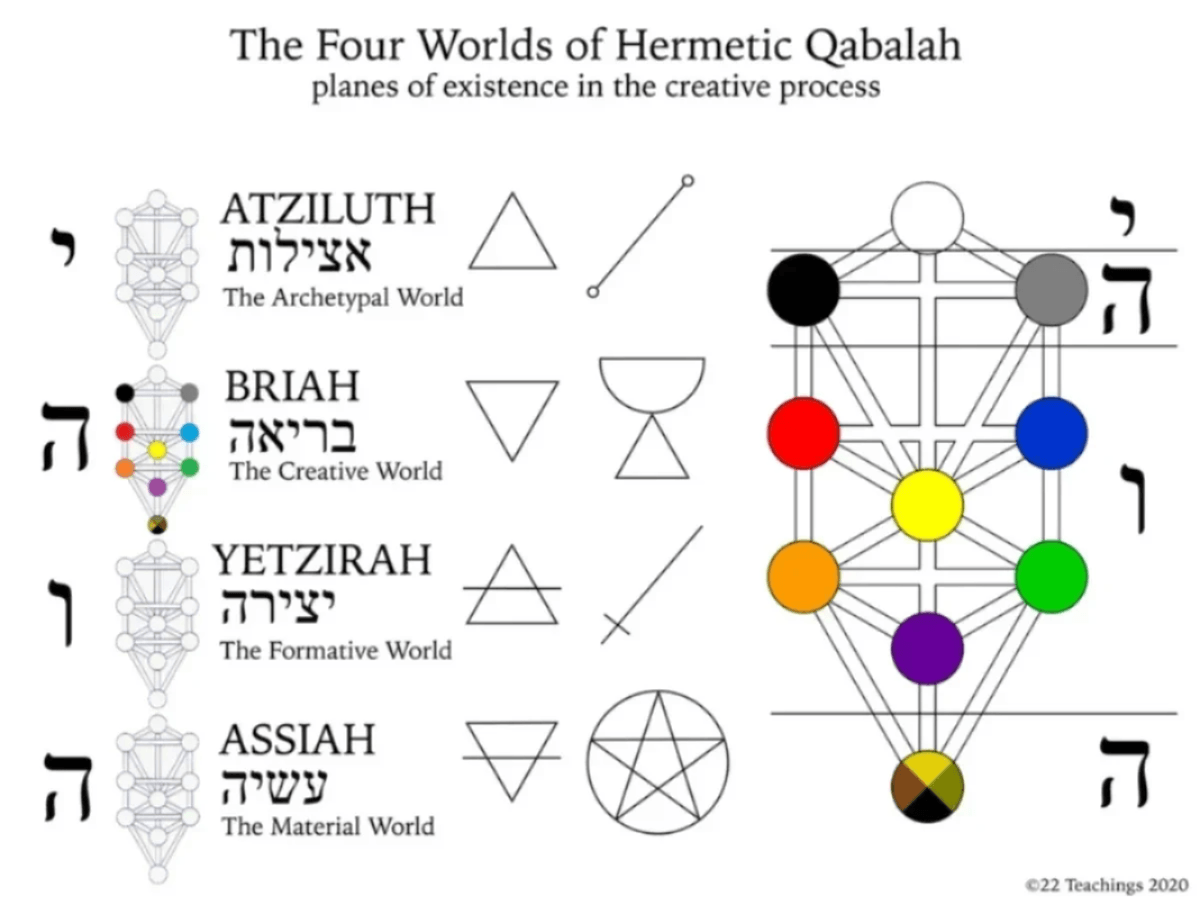
Consider the four directions, four classical elements, four seasons, and four Qabalistic Worlds:
World | Element | Expression |
|---|---|---|
Atziluth | Fire | Archetypal Will |
Briah | Water | Creative Understanding |
Yetzirah | Air | Formation and organization |
Assiah | Earth | Material expression |
The Emperor establishes the organizing authority necessary for Will to operate coherently throughout these Four Worlds.
Here we must distinguish between two important Qabalistic correspondences.
The Emperor is Tarot Key 4, but his traditional path is the 15th Path of Heh. His number also creates a meaningful symbolic relationship with the fourth Sephirah, Chesed.
These are related correspondences, not identical positions on the Tree of Life.
Chesed: The Benevolent Architect
Chesed means Mercy or Loving-Kindness and is associated with Jupiter.
Chesed represents expansive authority, benevolent leadership, generosity, and the establishment of a stable order.
Where Chokmah supplies primal force, Chesed gives that force the character of wise governance.
This is why the Emperor's authority should never be confused with tyranny.
True sovereignty is the ability to govern oneself without needing to dominate everyone else.
The Emperor who rules through wisdom becomes a protector.
The Emperor who rules through insecurity becomes a tyrant.
One builds a civilization; the other builds a prison and calls it government.
Astrology: Aries, Mars, and the Fire of Beginning
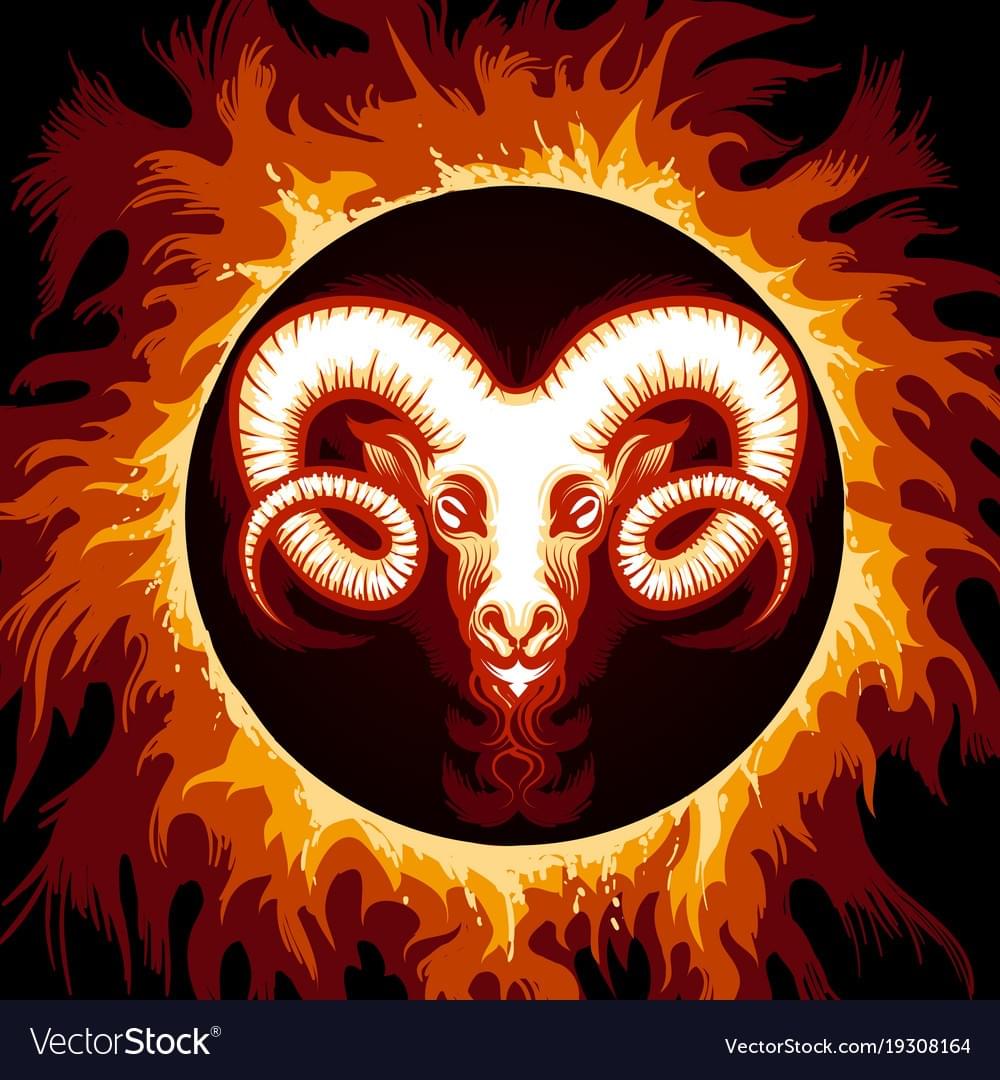
The Emperor is attributed to Aries, the first zodiacal sign, traditionally ruled by Mars.
Aries is Cardinal Fire: the initiating force that drives consciousness toward action, discovery, and accomplishment.
Mars supplies courage, energy, assertion, and the willingness to confront resistance.
However, Mars is not always destructive. Under disciplined direction, martial energy becomes strength, protection, decisive leadership, and perseverance.
The Emperor embodies this disciplined expression.
Aries asks, "What must be done?"
Mars responds, "Let's do it!"
The Emperor adds, "First, let us establish a workable plan."
That last statement is important, particularly when someone with an abundance of Aries energy decides to remodel the entire house before breakfast.
The Positive Qualities of Aries
Astrologically, Aries is traditionally associated with:
Courage and independence.
Leadership and personal initiative.
Enthusiasm and optimism.
Determination and competitive strength.
Creative beginnings.
Assertiveness and decisive action.
Its shadow can include impatience, impulsiveness, unnecessary conflict, stubbornness, and excessive dominance.
Naturally, individuals are more complex than their Sun signs. The entire natal chart must be considered.
In the Emperor, the fiery initiative of Aries becomes the ability to direct personal energy toward meaningful accomplishment.
Will without discipline is impulse. Will governed by wisdom becomes sovereignty.

The Emperor and Empress: The Alchemy of 0=2
One of the most important teachings concealed within the Tarot is that the Emperor and Empress represent complementary functions of the One Mind.
They are not merely a man and woman sitting on expensive chairs.
They are archetypal expressions of the cosmic relationship between Force and Form.
The Empress represents creative fertility, the living imagination, and the generation of forms.
The Emperor represents definition, measurement, organization, and the authority necessary to establish those forms within experience.
Neither functions independently.
The Mother generates possibilities, while the Father provides the organizing principle through which those possibilities become established realities.
Yet these titles describe metaphysical functions, not limitations imposed upon biological sex.
Every individual contains both capacities.
The Western Hermetic Formula: 0=2
Within the mystical formula 0=2, the apparent duality of existence emerges from an underlying unity.
The One becomes perceptible through complementary polarities:
Positive and negative.
Force and form.
Expansion and contraction.
Masculine and feminine.
Creative imagination and organizing intelligence.
These are not enemies competing for supremacy.
They are complementary expressions through which the One Mind becomes conscious of relationship.
In alchemical language, their harmonious union resembles the coniunctio oppositorum, the conjunction of opposites.
The Emperor without the Empress becomes sterile authority.
The Empress without the Emperor may symbolize creativity without sufficient definition.
Together, they establish the living architecture of manifestation.
One provides the creative possibilities; the other brings the measuring tape.
Even the universe must occasionally ask, "Will this fit?"
The Great Mother, Chokmah, and the Birth of the Solar Self
In Western Hermetic symbolism, Chokmah is called the Supernal Father, while Binah is the Great Mother.
Chokmah expresses the dynamic principle of Wisdom, and Binah receives, understands, and establishes the formative conditions of manifestation.
Interestingly, Chokmah is grammatically feminine in Hebrew, reminding us that theological representations of masculine and feminine principles cannot be reduced to ordinary human gender categories.
The divine polarities interpenetrate.
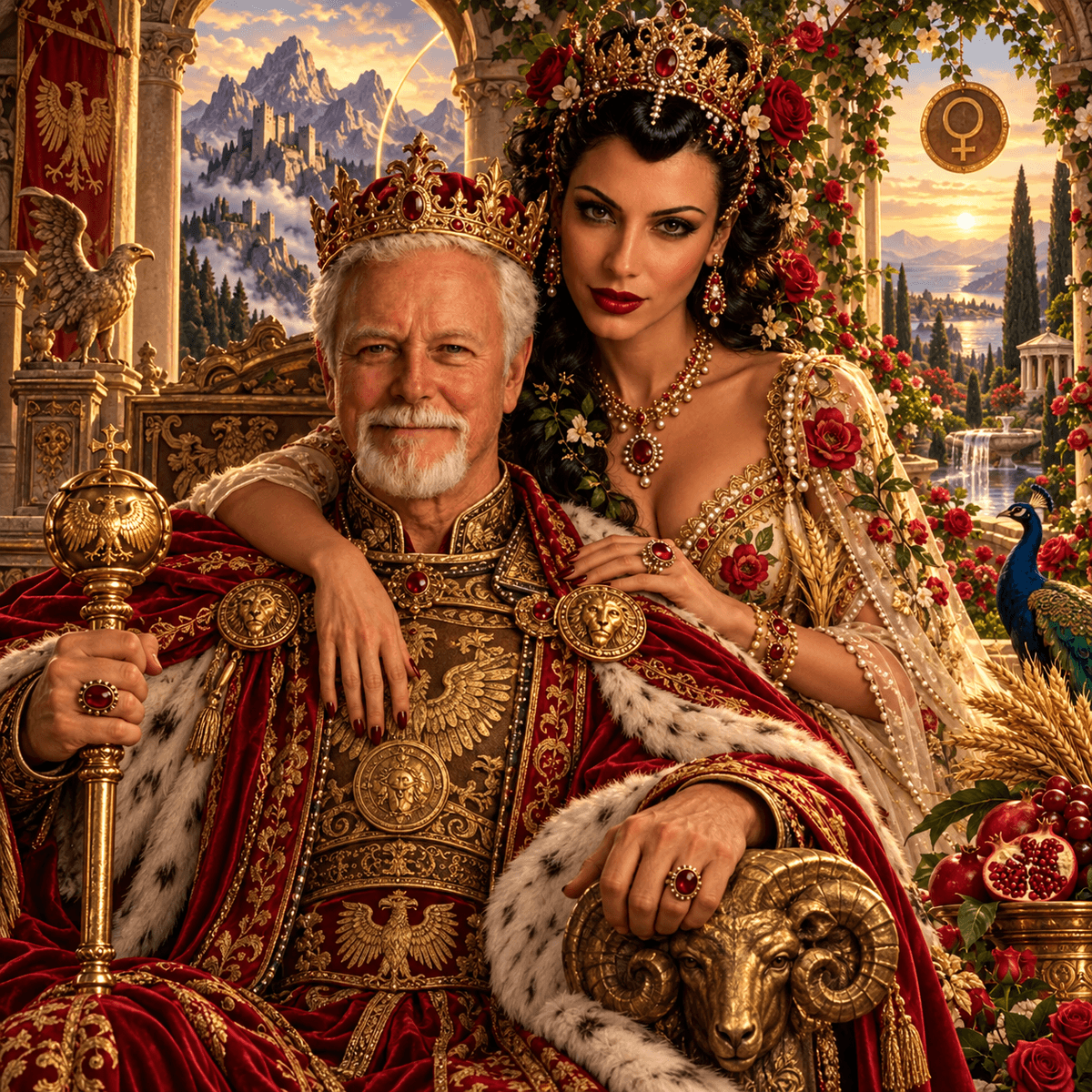
In the symbolic language of the Tarot, the Empress may be understood as the creative matrix through which consciousness conceives its possibilities, while the Emperor establishes the authority through which these become organized expressions.
Their relationship ultimately serves the emergence of Tiphareth: the Solar Child, the radiant center of harmonious individuality.
You are one of those Solar expressions of the One Mind.
Your existence is not simply an isolated physical event in the Hermetic interpretation. It is the individualized expression of a greater field of consciousness.
The Emperor represents the internal authority necessary for that individuality to become self-aware, responsible, and purposeful.
The Great Mother provides the creative possibilities of consciousness (Isis).
The Emperor (Osiris) establishes the boundaries through which consciousness can recognize itself as an individual being.
The Solar Child (Horus) learns to use both.
Metaphysics and Parapsychology: The One Mind and Its Three Expressions
In the Western Hermetic understanding presented here, consciousness is fundamentally One, although it expresses itself through different functional states.
These may be discussed as:
Unconscious: Processes and potentials outside ordinary waking awareness.
Subconscious: Habitual, associative, emotional, and imaginative processes that influence conscious experience.
Waking consciousness: The deliberate, reflective awareness through which we reason, choose, and organize our actions.
These are useful categories, but they should not be mistaken for three entirely separate minds.
In Hermetic philosophy, they may be contemplated as interrelated expressions of a greater unity.
Modern psychology also recognizes that conscious experience depends upon numerous interacting processes, although it does not establish the Hermetic proposition that the universe itself is One Mind.
From the perspective of parapsychological inquiry, experiences of intuition, spontaneous knowing, altered awareness, or unusual perception invite questions about the boundaries of ordinary cognition.
Such experiences remain subjects of investigation rather than scientific proof of universal consciousness.
The Emperor as the Organizing Faculty of Awareness
This is where the Emperor becomes particularly interesting.
Intuition may present an entire insight almost instantaneously, without the step-by-step reasoning ordinarily associated with verbal thought.
The Emperor represents the faculty that takes such an impression and gives it structure.
Intuitive knowledge becomes organized understanding.
Understanding becomes language.
Language becomes action.
Without this organizing faculty, even a profound intuitive realization may remain difficult to communicate.
Anyone who has attempted to describe a magnificent mystical experience knows the problem.
You have just encountered what seemed like the Infinite Intelligence of the Universe, and your vocabulary responds with:
"Well ... it was sort of ... you know ... very cosmic!"
The Emperor comes to the rescue with a few useful nouns, verbs, and definitions.
In this capacity, he becomes the mediator between intuitive reception and rational expression.

Jungian Psychology: The Emperor as Inner Authority
Carl Jung's theories provide another useful avenue for interpreting the Emperor.
In Jung's classical terminology, the anima represents an inner feminine image in a man's psyche, while the animus represents an inner masculine image in a woman's psyche.
These historically gendered concepts can also be approached more broadly as symbolic functions within the psyche, rather than rigid definitions of men and women.
The Emperor corresponds particularly well with the archetype of inner authority: the capacity to establish boundaries, assume responsibility, make decisions, and remain centered under pressure.
The Empress complements this with receptivity, imagination, emotional fertility, and the generation of possibilities.
Psychological integration requires that these functions work together.
An individual who identifies exclusively with authority may become emotionally disconnected.
Someone who identifies exclusively with receptivity may struggle to establish necessary boundaries.
The psychologically mature individual can both nurture and govern.
In Hermetic terms, the Emperor and Empress must meet face to face within the Soul.
When they do, the individual becomes less dependent upon externally imposed identities and more capable of expressing an authentic inner nature.
The goal is not to become the ruler of other people. It is to become the conscious sovereign of one's own life.
That is a considerably greater accomplishment.
The Alchemical Emperor: Sulfur, Fire, and the Philosopher's Stone
In alchemical symbolism, the Emperor may be associated with the fiery, active qualities of Sulfur.
Sulfur represents the dynamic, projective, and transformative principle of the alchemical triad.
Mercury represents mediation and fluid transformation, while Salt symbolizes fixation, embodiment, and stable manifestation.
These correspondences are symbolic applications rather than claims that Tarot figures literally represent chemical substances.
The Emperor's task is to bring the fire of Will into disciplined relationship with the other principles.
Uncontrolled fire destroys.
Directed fire transforms.
Within the alchemical vessel, heat must be regulated carefully. Too little, and transformation stalls; too much, and the work is ruined.
Likewise, personal Will must be tempered by intelligence and patience.
The Emperor represents the capacity to maintain the proper conditions for transformation.
His authority is not simply the power to command.
It is the wisdom to know when to act, when to wait, and when to stop interfering with the process.
This is the difference between the alchemist and the impatient cook who keeps opening the oven.
The Philosopher's Stone cannot be hurried merely because someone has another appointment!
Cosmic Theology: The Logos and the Architecture of Creation
In Hermetic theology, the Logos represents the ordering and intelligible expression of Divine Mind.
The Emperor participates symbolically in this organizing principle.
His function is to establish the relationships through which the limitless becomes knowable as a structured cosmos.
Here we encounter the relationship between infinity and measurement.
The Absolute is not limited by time, space, or individual form.
Yet manifestation requires distinctions.
There must be relationships between before and after, here and there, self and other.
The Emperor symbolizes the establishment of these distinctions.
In this sense, he may be called the Architect of Time, not because he literally creates physical time, but because he represents the organizing intelligence necessary for conscious experience to unfold through measurable relationships.
Likewise, his association with sacred geometry refers to the symbolic ordering of form through proportion, number, and harmony.
Modern cosmology describes spacetime and physical structures through mathematical relationships. Hermeticism approaches order as a metaphysical expression of Mind.
These are different ways of investigating reality; their symbolic similarities do not make them scientifically equivalent.
Nevertheless, the comparison is fruitful.
Both remind us that a universe without relationships would be difficult to describe, inhabit, or understand.
The Emperor is the archetypal assertion that manifestation possesses intelligible structure.
The Rider–Waite–Smith Emperor: The Ancient of Days
In the Rider–Waite–Smith Tarot, the Emperor appears as an aged sovereign seated upon a massive stone throne.
His long white beard suggests wisdom gained through experience, while his imposing posture communicates stability and command.
The ram heads decorating his throne identify his association with Aries.
His crimson robes reveal the fiery, active force of the martial principle. Beneath them, armor indicates readiness to defend the kingdom and its established boundaries.
This is not merely a ruler who issues commands.
He is also the guardian of what has been created.
The Ankh and the Orb of Dominion
In his right hand, the Emperor holds an ankh-shaped scepter.
The Egyptian ankh symbolizes life, and in Hermetic interpretation its union of loop and cross can be contemplated as the joining of complementary creative principles.
In his left hand is the Orb of Dominion, symbolizing worldly authority and the responsibility accompanying sovereignty.
Hermetically, we may also read the orb as a reflection of Tiphareth, the Solar center of the Tree of Life.
The Emperor thus holds both Life and Dominion.
One represents the living force that animates existence.
The other represents the authority required to administer it.
Mountains, Stone, and the River
Behind the Emperor rise barren mountains.
These represent endurance, stability, and the ability to withstand the storms of emotional and material experience.
The stone throne similarly suggests fixed authority.
Yet a small river flows through the landscape.
This detail is especially important.
The Emperor's world is not entirely devoid of feeling or creative fertility.
The water reminds us that the emotional and imaginative currents associated with the Empress remain present, even beneath the Emperor's severe exterior.
Without these waters, his kingdom would become spiritually barren.
The Emperor must govern the emotions without suppressing them.
After all, even the most commanding sovereign needs a heart beneath that armor.
The Wyspell Tarot Emperor: Sovereignty Magnified
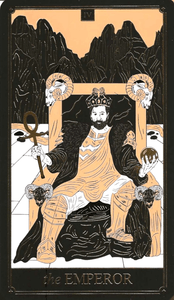
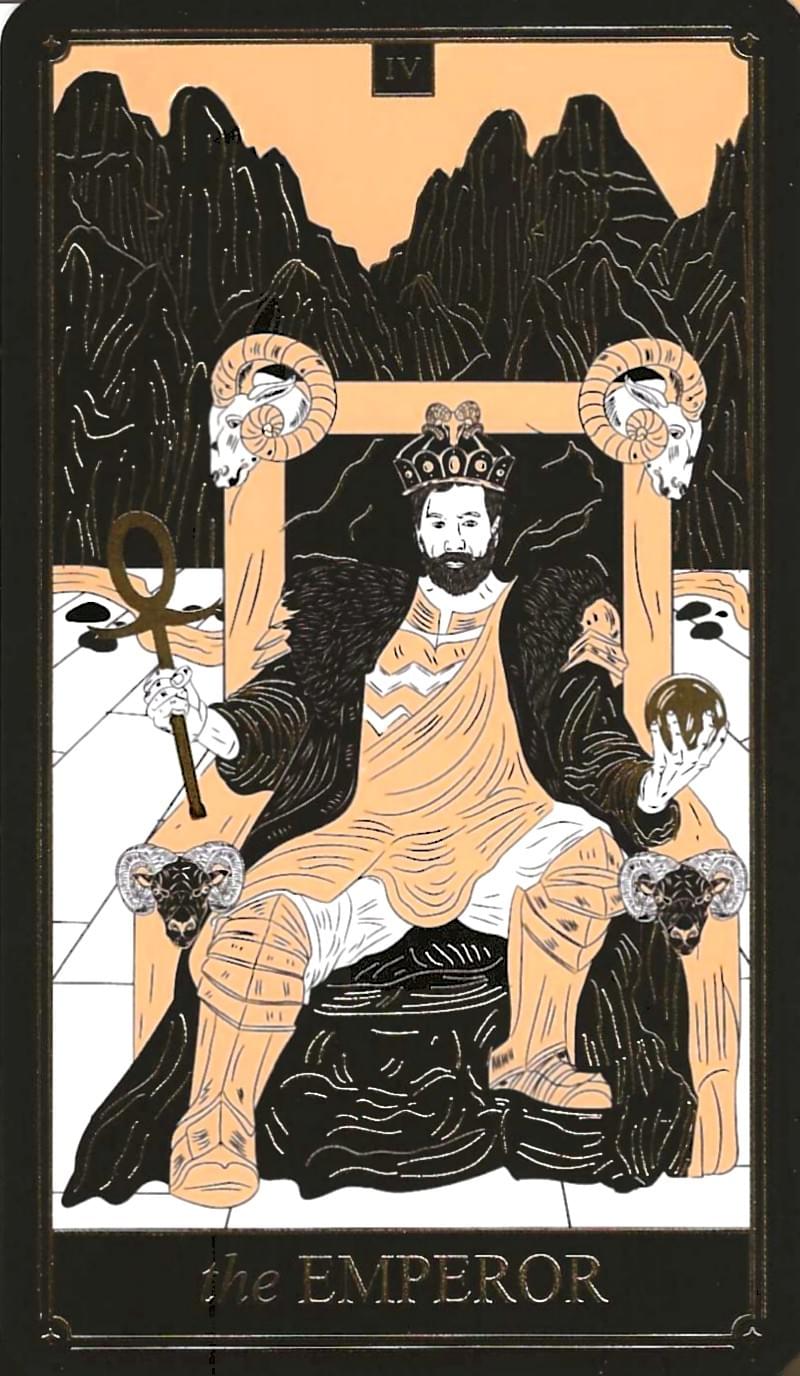
In Nataliia Habruk's Wyspell Tarot, the Emperor retains the fundamental symbolism established in the Rider–Waite–Smith tradition while presenting a more imposing image of sovereign authority.
He is depicted as a powerful, mature man seated upon an enormous throne decorated with ram heads.
His crown incorporates the ram symbolism of Aries, emphasizing his connection with Mars, initiative, and the establishment of personal dominion.
In his right hand rests the ankh scepter, while his left hand holds a dark orb.
He wears flowing robes over battle armor, reminding us that spiritual authority must possess both dignity and the strength to defend what it governs.
Behind him are a river and a magnificent mountain range.
The principal colors are muted orange, black, and white.
The Significance of Orange, Black, and White
From an interpretive Hermetic perspective, these colors offer another dimension of meaning.
Orange suggests the active warmth of creative energy and the authority to direct it.
Black represents hidden potential, restraint, and the unknown conditions from which manifested experience emerges.
White symbolizes illumination, clarity, and purified intention.
Together, they can be interpreted as the process by which latent possibilities become recognized, organized, and consciously directed.
The Emperor's relatively unreadable expression is equally interesting.
He does not appear particularly joyful, angry, or distressed.
His expression suggests emotional restraint.
This can be interpreted positively as impartial judgment and self-control.
However, it may also indicate the shadow of emotional distance.
When authority becomes excessively detached from feeling, leadership can deteriorate into cold administration.
A ruler who never listens to the people eventually discovers that the people have stopped listening to him.
Comparing the Two Emperors
Rider–Waite–Smith Emperor | Wyspell Emperor |
|---|---|
Traditional sovereign and lawgiver | Magnified image of commanding authority |
Strong red robes emphasizing martial vitality | Muted orange, black, and white emphasizing power and restraint |
Stone throne decorated with Aries rams | Massive throne with prominent ram symbolism |
Ankh-shaped scepter and orb | Ankh scepter and dark orb |
Austere mountains and subtle flowing water | Dramatic mountains and river |
Emphasis on established, enduring order | Emphasis on powerful, personally embodied sovereignty |
Both cards present the same essential Hermetic teaching:
Authority is not simply the possession of power. It is the intelligent responsibility to direct that power.
The Emperor and the Thoth Tarot: The Heh–Tzaddi Question
Readers familiar with Aleister Crowley's Thoth Tarot will recognize an important difference between the traditional Golden Dawn correspondences and Crowley's later system.
In the classical Golden Dawn and Paul Foster Case arrangement:
Emperor — Heh, 15th Path, Aries.
Star — Tzaddi, 28th Path, Aquarius.
Crowley proposed exchanging the Hebrew-letter attributions of the Emperor and Star, drawing upon Liber AL vel Legis and explaining his interpretation in The Book of Thoth.
The resulting relationship has generated considerable discussion among Western Hermetic students.
For this comparison of the Wyspell and Rider–Waite–Smith decks, I retain the traditional Emperor–Heh–15th Path correspondence.
My reason is straightforward: the Constituting Intelligence provides an exceptionally coherent explanation of the Emperor's function as the organizer of Divine Will within Solar consciousness.
This does not prevent students of the Thoth Tarot from studying Crowley's interpretation.
Indeed, examining differences between esoteric systems can deepen our understanding of the Tarot's symbolic language.
What matters is that we understand which system we are using and why.
Otherwise, we may find ourselves climbing the Tree of Life only to discover we have brought the wrong map!
When the Emperor Is Well Dignified
The card indicates:
Personal sovereignty and responsible leadership.
Self-discipline and emotional stability.
Establishing healthy boundaries.
Building a strong foundation for future success.
Financial organization and responsible management.
Courage, determination, and perseverance.
Protection, guidance, and mentorship.
Harmony between spiritual intention and material action.
Rational decision-making informed by wisdom.
The achievement of ambitions through organized effort.
The Emperor reminds the querent that success often requires patience and consistent action.
In matters of career or business, he may indicate promotion, greater responsibility, or recognition as a capable leader.
In relationships, he can represent stability, dependability, protection, and commitment.
However, the surrounding cards must determine whether these qualities are genuinely supportive.
When the Emperor Is Ill Dignified
In Western Hermetic Tarot practice, reversals are unnecessary when elemental dignities and surrounding cards provide sufficient interpretive context.
Nevertheless, for readers who employ reversed cards in the Rider–Waite–Smith or Wyspell systems, the shadow meanings may include:
Tyranny, domination, or controlling behavior.
Stubbornness and unwillingness to compromise.
Emotional repression or excessive coldness.
Abuse of authority.
Power struggles within relationships.
Reckless or impulsive decisions.
Poor financial discipline.
Fear of losing control.
Abdication of personal responsibility.
Excessive rigidity and resistance to change.
The Emperor's shadow emerges when the need for order becomes an obsession with control.
He may attempt to impose his Will upon others instead of mastering himself.
Such behavior is not genuine sovereignty.
It is insecurity wearing a crown.
A particularly uncomfortable crown, at that!
The Emperor's Lesson in Love and Relationships
The Emperor can signify a dependable, protective partner who values commitment, stability, and responsibility.
However, there is an important distinction between protecting someone and controlling them.
Healthy love establishes boundaries without imprisoning the beloved.
The Emperor must remember that the Empress is his equal in the creative process.
She is not his possession.
Indeed, their symbolic relationship demonstrates that masculine and feminine creative principles are mutually necessary.
The person who identifies strongly with the Emperor may benefit from greater receptivity, tenderness, and emotional expression.
Likewise, someone who struggles to establish boundaries may need to develop the Emperor's decisiveness and self-possession.
Love does not require surrendering sovereignty. It requires sharing life without attempting to govern another person's soul.
Invoking the Emperor: The Magick of Inner Sovereignty
In Western Hermetic Magick, invoking the Emperor means consciously awakening the organizing intelligence of the Higher Self.
This is not an invocation of domination.
It is an act of spiritual self-government.
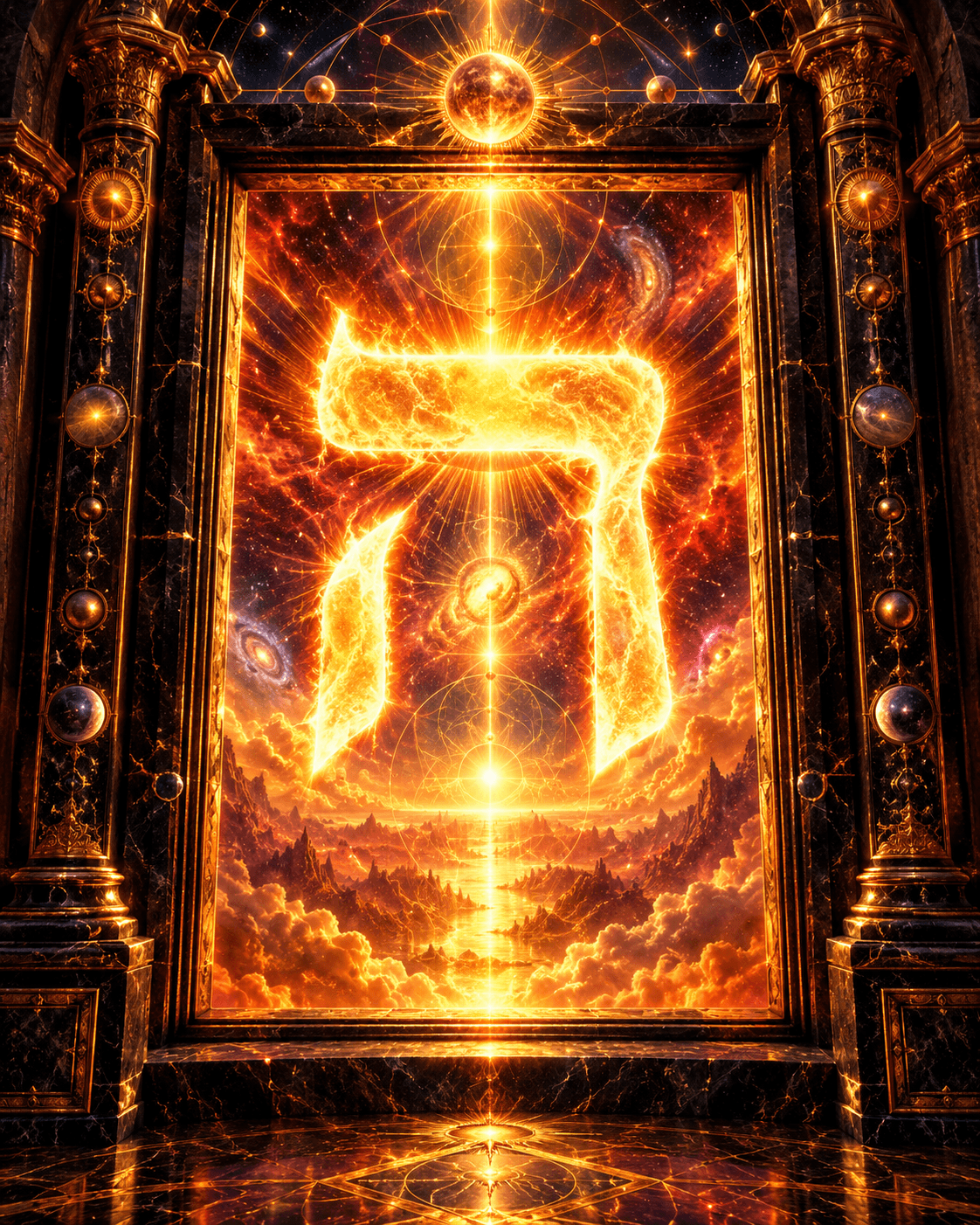
A simple contemplative practice can be performed as follows:
Sit upright and become aware of your breathing.
Visualize a radiant golden Sun within your heart, representing Tiphareth.
Imagine a current of brilliant, fiery intelligence descending from Chokmah into that Solar center.
Contemplate the Hebrew letter Heh (ה) as a luminous window through which Divine Wisdom becomes conscious understanding.
Consider one area of your life that requires greater discipline, clarity, or structure.
Formulate one practical action that will bring that area into greater harmony.
Then affirm:
I am the sovereign of my thoughts, the guardian of my actions, and the architect of my experiences.
By Wisdom, I establish order.
By Understanding, I recognize the purpose of creation.
By Beauty, I bring my Will into harmony with my Higher Self.
I do not seek dominion over others, for the greatest kingdom is the Self.
Let my authority be guided by compassion, my strength tempered by wisdom, and my actions established in Truth.
So mote it be.
Remember that the realization of the Emperor does not occur simply because we have declared ourselves sovereign.
The declaration must become action.
A person may invoke the Emperor every morning, but if the bills remain unpaid, the promises unfulfilled, and the household in chaos, the Constituting Intelligence still has work to do!
Real magick requires participation.
Conclusion: Become the Emperor of Your Own Kingdom
The Emperor is far more than an image of patriarchal authority.
He represents a fundamental principle of manifestation: the intelligent organization of Divine Will.
Through the 15th Path of Heh, the limitless potential of Chokmah is related to the radiant Solar consciousness of Tiphareth.
Through the number Four, we encounter stability, foundation, and the establishment of order.
Through Aries and Mars, we encounter the fiery courage required to initiate action.
Through Chesed, we recognize the spiritual necessity of mercy, generosity, and responsible leadership.
Through the complementary presence of the Empress, we discover that creative power requires both generation and organization.
And through Jungian psychology, we can contemplate the Emperor as an archetype of internal authority and psychological integration.
Ultimately, the Emperor asks one essential question:
Are you consciously governing your life, or have you surrendered your sovereignty to circumstances, fears, and the opinions of others?
The answer is not found in the size of your kingdom, the number of people who obey you, or the impressive titles you have accumulated.
It is found in the relationship between your Will, your Wisdom, and your actions.
For the true Emperor does not merely command.
He understands, organizes, protects, and takes responsibility for what he creates.
The Empress gives birth to the possibilities of Life.
The Emperor establishes the conditions through which those possibilities become living realities.
Together, they reveal the sacred polarity of the One Mind.
And you, dear reader, are the Solar Child through whom that creative relationship becomes a conscious experience.
Remember:
Tarot is a map, and the Tree of Life reveals the architecture of the journey.
Above all things, know thyself.
A Closing Blessing from the Tarot of Eli
Thank you for your interest, thoughtful comments, and generous, supportive donations. Your participation helps keep the Living Light of Western Hermetic Qabalah and Tarot available to all who seek greater knowledge of themselves.
May the Wisdom of Chokmah illuminate your Will, the Understanding of Binah nurture your creative spirit, the Mercy of Chesed guide your authority, and the golden Light of Tiphareth reveal the sovereignty of your Higher Self.
May you have the courage to build, the wisdom to govern, and the compassion to remember that true power never requires diminishing another.
May you live long, prosper, and reign wisely over the magnificent kingdom of your own Soul!
— Magus Eli Serabeth
3 Western Hermetic Tarot and Magick websites helping people become more magick and less tragic since 2010.
Traditional Tarot Card Comparisons blog, Traditional Tarot Card decks and books in Tarot store.
Home page, Tarot Store, Master Tarot Classes, Thoth Tarot Cards, Book of Thoth, and nontraditional Tarot Card Comparisons.
Western Hermetic Magick website and ritual invocations blogs.
