

#tarotqabalahtraditionalelitarot2strikingly.com
Above all things, know thyself.
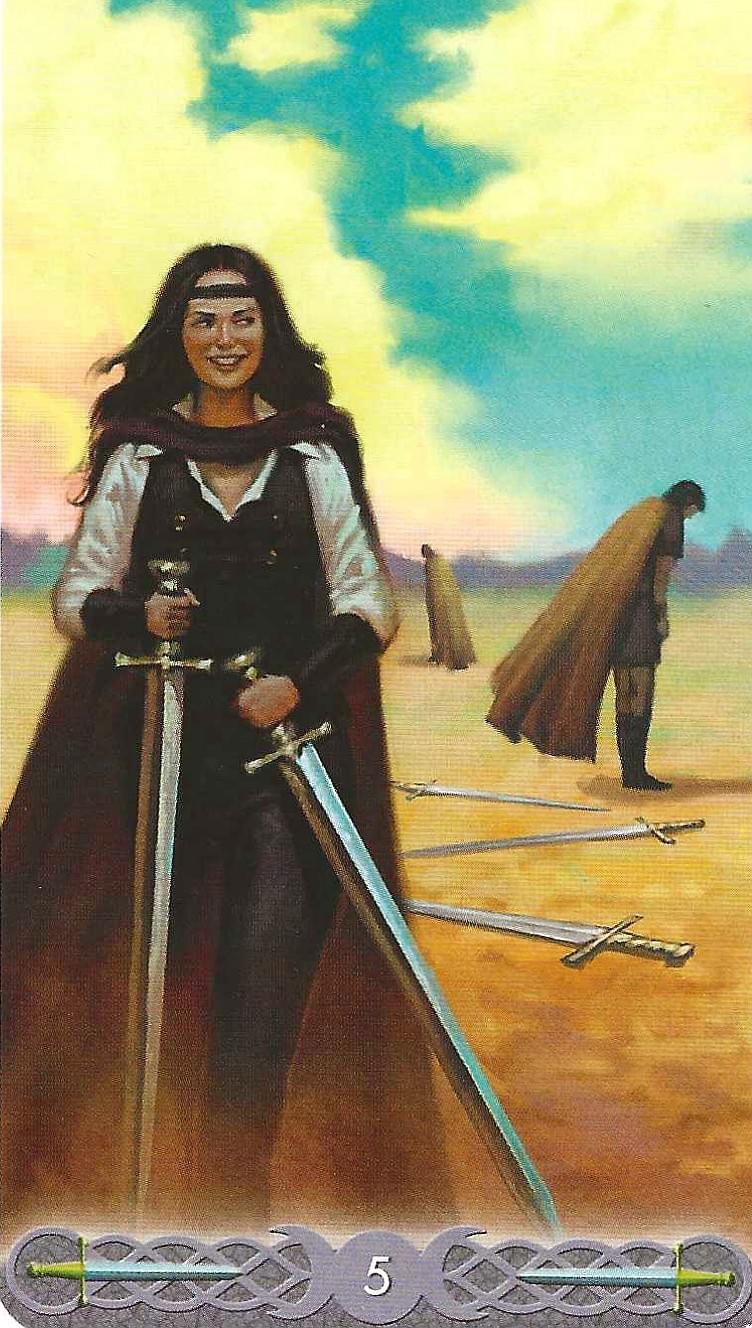
5 of Swords-Triple Goddess Tarot
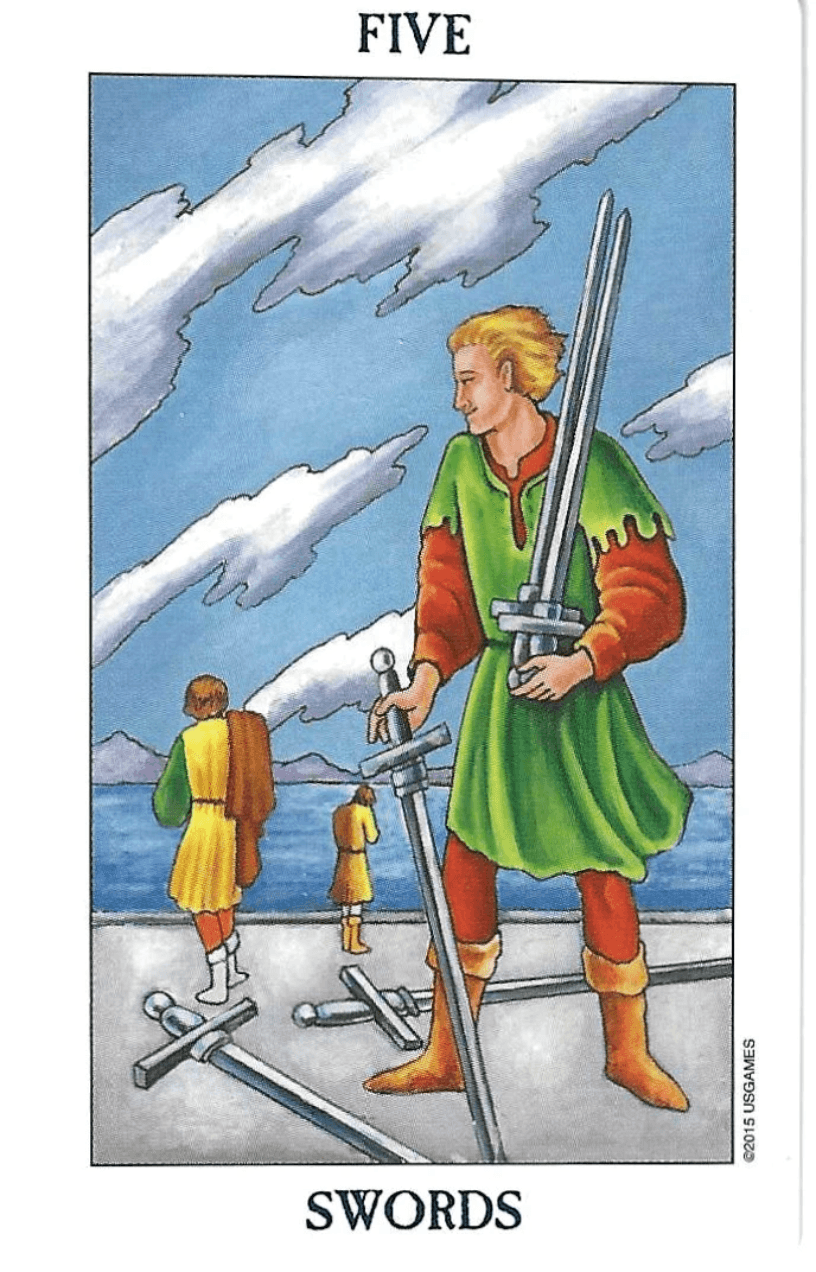
Radiant: Rider-Waite-Smith Tarot-5 of Swords
The Rider–Waite–Smith Five of Swords presents the more outward, mundane divinatory meaning of loss, defeat, and failure. A contest has been decided; the matter is finished, and the victor gathers the spoils. Those spoils are symbolized by the swords — thoughts, strategies, and mental weapons — scattered upon the ground. The defeated figures retreat in the background, their bowed heads and stumbling posture reinforcing the atmosphere of humiliation. Above them, dark, wind-torn clouds imply the unseen “winds of defeat” — the subtle currents of thought and intention that have shifted against the querent.
Yet, true to his initiatory obligations, Waite veils the deeper arcane structure underlying the image. The Golden Dawn system from which he drew did not publicly expose the full Western Hermetic Qabalistic correspondences, particularly those tied to the Sephiroth and planetary forces.
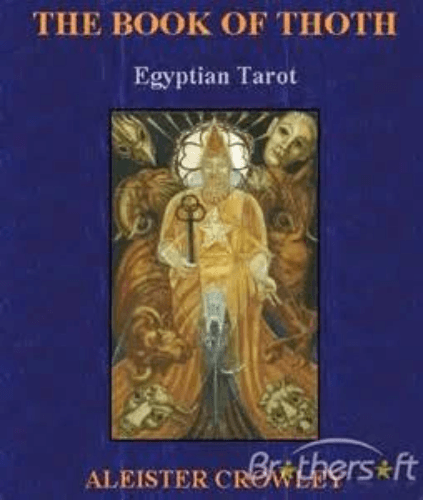
In Western Hermetic Tarot, most explicitly preserved in the The Book of Thoth and the Thoth Tarot, the Five of Swords is attributed to Venus in Aquarius.
Here we encounter a profound paradox:
Venus seeks harmony, attraction, and relational equilibrium.
Aquarius operates through abstract principle, cold intellect, and collective ideology.
Venus, the principle of cohesion, placed in the detached and idealized sign of Aquarius, produces dissonance. Harmony attempts to function through impersonal reason. Love becomes theory. Relationship becomes strategy. The heart is filtered through ideology.

On the Tree of Life, the Five corresponds to Geburah, the sphere of severity. Thus, Venus — ordinarily soft and connective — is forced through the corrective fire of Mars’ domain. The result is conflict born from mental idealism, where one may win the argument yet lose the relationship.
This is not mere defeat — it is misapplied intellect severing harmony.
Where the Rider–Waite–Smith emphasizes external loss, the Hermetic lens reveals an initiatory tension:
When does intellectual superiority become isolation?
When does “being right” cost us Venusian unity?
When does the mind cut so sharply that it fragments its own alliances?
The Five of Swords, therefore, is not simply humiliation. It is the friction between idealism and affection — the struggle of abstract truth against living connection.
Where the Rider–Waite–Smith emphasizes external loss, the Hermetic lens reveals an initiatory tension:
When does intellectual superiority become isolation?
When does “being right” cost us Venusian unity?
When does the mind cut so sharply that it fragments its own alliances?
The Five of Swords, therefore, is not simply humiliation. It is the friction between idealism and affection — the struggle of abstract truth against living connection.
In mundane readings: conflict, pride, hollow victory.
In Hermetic initiation: the lesson of reconciling Venusian love with Aquarian principle before severity crystallizes into alienation.
The Triple Goddess Tarot – Five of Swords presents a scene closely aligned with the traditional structure of the Rider–Waite–Smith image, yet with a subtle but meaningful shift in archetypal emphasis.
In the foreground stands a smiling female figure, confidently holding two broad swords. Behind her, three additional swords lie abandoned upon the ground — the spoils of conflict. In the distance, two male figures retreat with stooped shoulders and bowed heads, their posture unmistakably communicating defeat and humiliation.
At first glance, the card mirrors the RWS composition almost exactly. However, the substitution of a woman as the victorious figure reframes the dynamic. The emphasis shifts from a purely ego-driven triumph to a more nuanced expression of strategic intelligence, instinctual awareness, and perhaps even emotional calculation. This is not brute conquest — it is psychological advantage.
The smile on her face is particularly telling. It may signify satisfaction — but it may also imply irony. Has she truly won? Or has she merely outmaneuvered others in a contest that ultimately diminishes everyone involved?
Like the RWS version, the atmosphere suggests hollow victory. The grounded swords symbolize mental positions defeated, arguments silenced, or alliances fractured. The walking figures reinforce the theme: someone has prevailed, but the relational field has suffered.
Where this card deepens is in its implicit lesson:
There are battles not worth prolonging.
There are victories that cost more than they are worth.
There are moments when walking away is greater mastery than striking again.
Thus, the card advises discernment. It cautions against retaliation and warns against the temptation to “get even.” The true power here lies not in domination, but in recognizing when conflict has already extracted its toll.
Rider–Waite–Smith vs. Triple Goddess Synthesis:
Both cards depict hollow victory and mental defeat, but the Rider–Waite–Smith emphasizes ego-driven humiliation and external loss, while the Triple Goddess subtly reframes the triumph through feminine strategy — highlighting discernment, knowing when to disengage, and resisting retaliatory pride.

Both numerology and gematria (Qabalistic numerology) attribute distinct yet interconnected characteristics to the number 5, each within their respective traditions. Here’s an overview of the number 5's characteristics in both systems:
Numerology
In numerology, numbers are seen as symbols that carry specific vibrations and meanings. The number 5 is often associated with:
Freedom and Adventure:
- The number 5 is considered the number of freedom, adventure, and change. It is dynamic and full of energy, symbolizing the pursuit of new experiences and the desire for independence.
- Individuals influenced by the number 5 are often seen as explorers, curious and eager to embrace life's variety. They tend to resist routine and seek excitement and diversity in their experiences.
Versatility and Adaptability:
- The number 5 is also linked to adaptability and versatility. People with this number in their numerological chart are usually quick to adapt to new circumstances and are comfortable with change.
- This number reflects a flexible and resourceful nature, capable of handling different situations with ease.
Sensuality and the Physical Experience:
- The number 5 is closely associated with the five senses, symbolizing the physical experience and the pleasures of the material world. It represents a deep appreciation for sensory experiences, including taste, touch, sight, sound, and smell.
- This connection to the senses also ties the number 5 to creativity and expression through various forms of art and physical activity.
Restlessness and Impulsiveness:
- The energy of the number 5 can also manifest as restlessness or impulsiveness. People under its influence might struggle with consistency or long-term commitments, as they are driven by the need for constant stimulation and new experiences.
Gematria
In gematria, each Hebrew letter corresponds to a number, and these numbers carry deep mystical significance. The number 5, represented by the Hebrew letter "ה" (Heh), has its own set of meanings:
Divine Grace and Creation:
- The letter Heh is associated with divine grace and the breath of life. It is often seen as a symbol of creation, as it represents the breath of God that brings life into existence.
- In both Western Hermetic Qabalah and Jewish Kabbalistic thought, Heh's connection to creation makes the number 5 a symbol of divine intervention and the manifestation of spiritual energy in the material world.
Names of God and Holiness:
- The number 5 is significant in the Tetragrammaton (YHWH), the ineffable name of God, where the letter Heh appears twice. This repetition emphasizes the sacred nature of the number and its association with holiness.
- In this context, the number 5 represents the presence of God in the world and the sanctity of creation.
Pentateuch (Five Books of Moses):
- The number 5 corresponds to the five books of Moses, also known as the Torah, which are central to Jewish religious teachings. This connection reinforces the number's association with divine wisdom, law, and spiritual guidance.
- The number 5, therefore, represents the foundation of spiritual knowledge and the covenant between God and humanity.
Geburah - Strength and Judgment:
- In Qabalah/Kabbalah, the fifth sephirah on the Tree of Life is Geburah, meaning "Strength" or "Severity." Geburah represents the force of judgment, discipline, and the application of justice.
- The number 5, in this context, is connected to the energies of Mars, symbolizing courage, action, and sometimes conflict. It represents the necessary power to enforce boundaries and uphold divine order.
Comparative Summary
Freedom and Adventure vs. Divine Grace: Numerology emphasizes the number 5's association with freedom, change, and adventure, while gematria focuses on its connection to divine grace, creation, and the breath of life.
Versatility vs. Holiness: In numerology, 5 signifies versatility and adaptability, while in gematria, it relates to holiness and the sacred names of God.
Sensuality vs. Spiritual Law: Numerology links 5 to the physical senses and sensual experiences, whereas gematria ties it to the Torah and spiritual law.
Restlessness vs. Strength and Judgment: The potential for restlessness in numerology contrasts with the disciplined strength and judgment represented by Geburah in gematria.
Both systems highlight the transformative and dynamic qualities of the number 5, whether through the lens of personal freedom and exploration or through spiritual creation and divine order.

There is yet another dimension and/or mindscape to the number 5 when we compare it to the 5th house on the Astrological chart. The 5th house in an astrological chart is one of the twelve houses, each representing different areas of life. The 5th house is traditionally associated with creativity, pleasure, and self-expression. Here's a detailed look at what the 5th house characterizes:
Themes of the 5th House
Creativity and Artistic Expression:
- The 5th house is known as the "house of creativity." It governs all forms of creative self-expression, including art, music, writing, and any activities where personal flair and originality are involved.
- This house also relates to hobbies and pastimes that allow individuals to express their creative side, from painting and crafting to theater and dance.
Romance and Love Affairs:
- The 5th house is often referred to as the "house of romance." It represents love affairs, dating, and the more playful aspects of romantic relationships.
- Unlike the 7th house, which governs long-term partnerships and marriage, the 5th house focuses on the initial stages of romance and the joy of falling in love.
Children and Childlike Joy:
- This house is strongly connected to children, both in terms of one's own offspring and the general concept of childlike joy and innocence.
- It governs matters related to pregnancy, childbirth, and one's relationship with their children. The 5th house also relates to the inner child and the ability to approach life with a sense of playfulness and wonder.
Pleasure and Entertainment:
- The 5th house is associated with pleasure and enjoyment, including recreational activities, sports, games, and anything that brings joy and amusement.
- It also covers indulgences like parties, celebrations, and other forms of entertainment where one seeks to have fun and enjoy life.
Speculation and Gambling:
- The 5th house is linked to risk-taking activities, including speculation, gambling, and investments. It represents the thrill of taking chances and the potential rewards or losses that come with it.
- This can extend to financial speculation, betting, or any situation where there is an element of risk and reward.
Personal Talents and Interests:
- This house highlights personal talents, skills, and areas where one can shine and stand out. It’s about what makes an individual unique and how they express their individuality.
- The 5th house encourages exploration of personal interests and the development of one's innate abilities.
Rulership and Influence
Zodiac Sign and Planetary Ruler:
- The 5th house is naturally ruled by Leo, the sign associated with the Sun. This connection to Leo and the Sun emphasizes the house's focus on self-expression, creativity, and the pursuit of joy.
- The planetary ruler of the 5th house, therefore, is the Sun, which governs individuality, vitality, and the essence of one's being.
Planets in the 5th House:
- Planets located in the 5th house can significantly influence how these themes manifest in a person's life. For example:
- Venus in the 5th house might enhance artistic talents and create a strong desire for romance and beauty.
- Mars might bring a competitive edge to sports or creative pursuits and a passionate approach to love affairs.
- Jupiter could expand the areas of pleasure and creativity, potentially bringing abundance in romantic experiences or luck in speculation.
- Planets located in the 5th house can significantly influence how these themes manifest in a person's life. For example:
Summary
The 5th house in astrology is a vibrant and dynamic area of the chart that governs creativity, romance, children, pleasure, and personal expression. It’s the place where one seeks joy, indulges in artistic and playful activities, and expresses their true self. Through the 5th house, individuals connect with their inner child, explore love and affection, and take creative risks that add color and excitement to life. Hence, the 5 of swords can show a temporary defeat in achieving these goals.

In astrology, Venus represents love, relationships, beauty, and aesthetics, while Aquarius is associated with innovation, uniqueness, and a forward-thinking approach. When Venus is in the house of Aquarius, certain characteristics and dynamics come into play:
Unconventional Love: Venus in Aquarius tends to express love and affection in unconventional ways. This placement may bring a willingness to explore non-traditional relationship structures and values uniqueness in partnerships.
Intellectual Connection: Aquarius is an air sign known for its intellectual nature. With Venus in Aquarius, there's often a strong emphasis on mental stimulation in relationships. Intellectual conversations and shared ideas become significant elements of romantic connections.
Friendship in Love: Aquarius is traditionally ruled by Saturn, emphasizing the importance of friendship in relationships. Venus in Aquarius tends to approach love with a friendly attitude, valuing a deep connection at the intellectual and emotional levels.
Humanitarian Values: Aquarius is associated with humanitarian ideals and a concern for the collective. When Venus is in this sign, there may be a desire for relationships that contribute positively to society or involve shared goals for the greater good.
Independent Expression of Love: Individuals with Venus in Aquarius appreciate their independence and often give their partners the freedom to express themselves. They may resist traditional norms in relationships and seek out partners who embrace their uniqueness.
Embracing Change: Aquarius is open to change and innovation. In matters of the heart, Venus in Aquarius may be more adaptable to new ideas and approaches in relationships, welcoming evolution and growth over time.
Progressive Aesthetics: Venus also represents aesthetics, and in Aquarius, there's a preference for modern and progressive styles. This could manifest in a unique sense of fashion or an appreciation for avant-garde artistic expressions.
Remember, the characteristics of Venus in Aquarius can be influenced by other aspects in the birth chart, so individual experiences may vary. If you have specific details about your birth chart, a more personalized analysis could provide additional insights.
Divinatory Implications
When the 5 of Swords card appears in a layout, it may indicate:
Hostility or competitive tension.
Testing one’s mental or strategic prowess.
Acting from selfish motives or pride.
Winning against the odds through force of will.
A situation where someone must lose for another to prevail.
It can also suggest that the querent is either:
Claiming victory in a morally ambiguous situation,
orBeing advised to disengage before further damage occurs.
If ill-defined by surrounding cards, it may warn of:
Escalating conflict.
Bitterness following confrontation.
Ego-driven decisions that isolate rather than empower.
In essence, this Five of Swords asks a quiet but penetrating question:
Is the victory strengthening your sovereignty — or merely feeding the ego?
Thank you for your interest, your thoughtful comments, subscriptions, and your generous support.
Your donations help keep this work alive and accessible to all sincere seekers.
May your generosity return to you in abundance. Your subscriptions are free and at bottom of page is the subscription box. May you live long and prosper.
3 Western Hermetic Tarot and Magick websites helping people become more magic and less tragic since 2010.
Traditional Tarot Card Comparisons blog and tarot layout store.
Home page, Tarot Store, Western Hermetic Tarot Classes, and Nontraditional Tarot Card Comparisons blog.
Western Hermetic Magick ritual and invocation website. Magick blogs.
