
elitarot2strikingly.com
Above all things, know thyself!
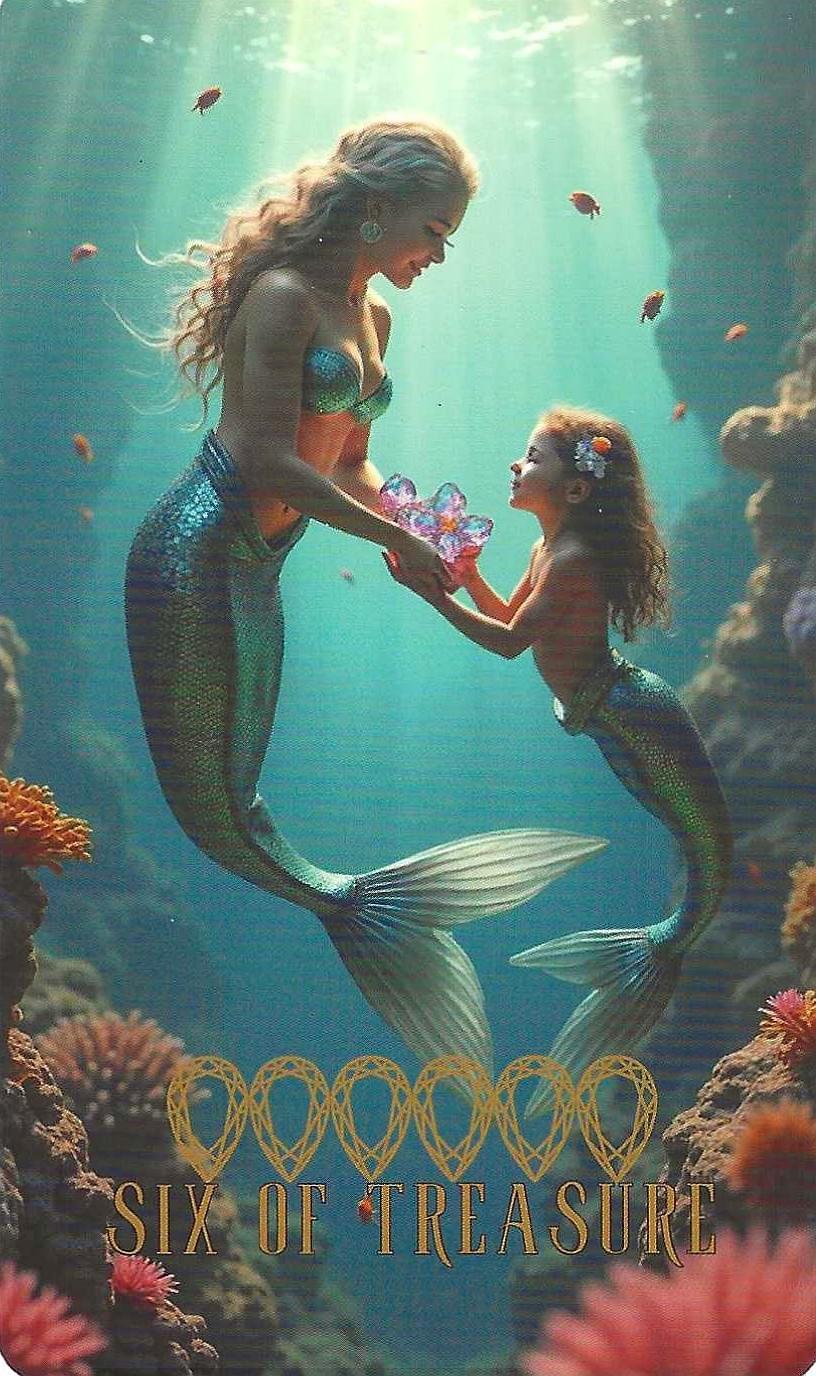
The Ocean Tarot-Six of Treasure
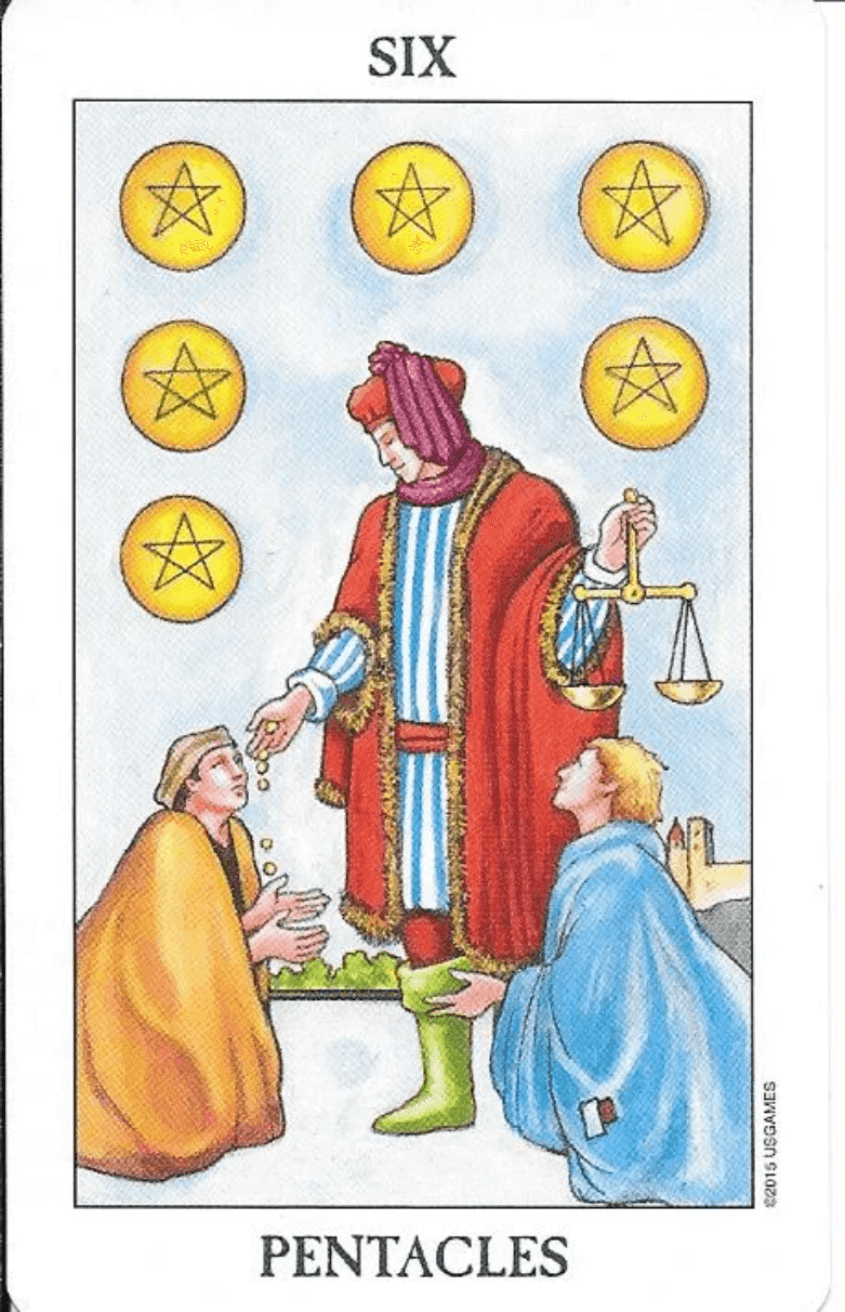
Rider-Waite-Smith- Six of Pentacles
The Rider–Waite–Smith Six of Pentacles
Generosity, Reciprocity, and the Solar Circulation of Prosperity
The Rider–Waite–Smith Six of Pentacles depicts a prosperous merchant holding a balance scale while distributing coins to two kneeling figures. On the surface, the image presents charity, financial assistance, patronage, and the responsible distribution of material resources.
The scales suggest that the merchant is not giving impulsively. He measures what is offered, to whom it is given, and perhaps why it is being given. This is generosity governed by discrimination rather than sentimentality.
Above the scene, six golden Pentacles form an ordered pattern, suggesting that a greater harmony presides over the earthly exchange below. The card therefore represents accomplishment in business, successful material negotiations, the payment of debts, and the balanced circulation of wealth.
Its first lesson is simple: prosperity thrives through movement. Money locked away in fear becomes stagnant. Money directed wisely becomes opportunity, nourishment, employment, education, and growth. Even coins, it seems, dislike being imprisoned in a dark vault for too long.
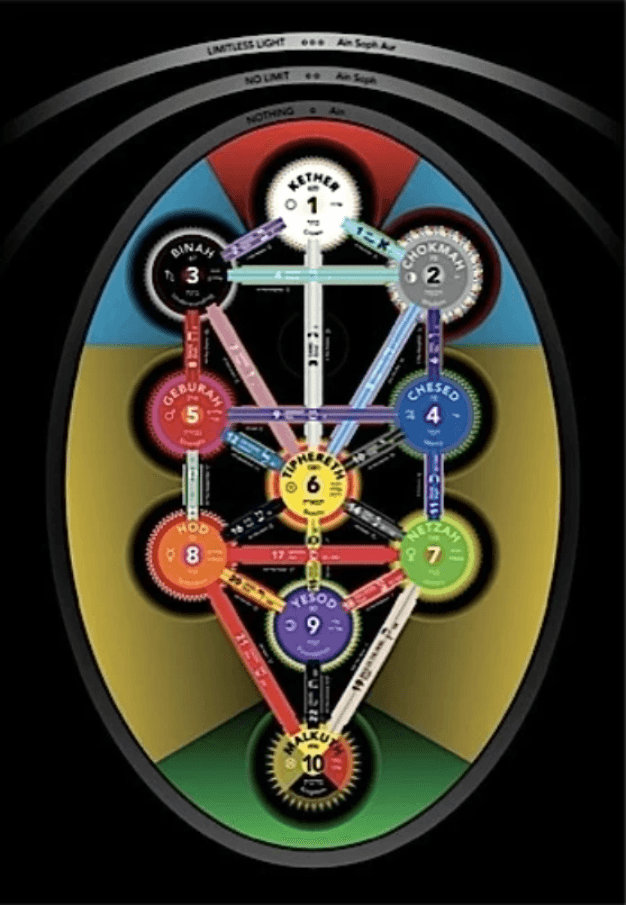
The Number Six: Beauty and Solar Consciousness
In Tarot numerology, six represents harmony, accomplishment, equilibrium, and the successful fruition of previous effort. Within Western Hermetic Qabalah, the number six belongs to Tiphareth, the sixth Sephira on the Tree of Life.
Tiphareth means Beauty. It occupies the central position of the Tree and acts as the radiant heart of the Qabalistic system. It is associated with the Sun, the Higher Self, the Soul, and the harmonizing consciousness that brings the surrounding planetary powers into balanced relationship.
Tiphareth is often described as the seat of the Christ, Buddha, Osiris, Dionysus, or Solar consciousness. These figures should not be reduced to competing religious personalities. They represent variations of the same theological mystery: Divine Consciousness entering form, undergoing sacrifice, and returning renewed.
At the level of Tiphareth, generosity is no longer merely a social virtue. It becomes an expression of Solar consciousness. The Sun does not negotiate with the planets before offering its light. It shines because radiance is its nature.
The spiritually awakened personality behaves in much the same way. It gives from strength, not guilt; from abundance, not self-erasure; and from wisdom, not the need to appear virtuous.
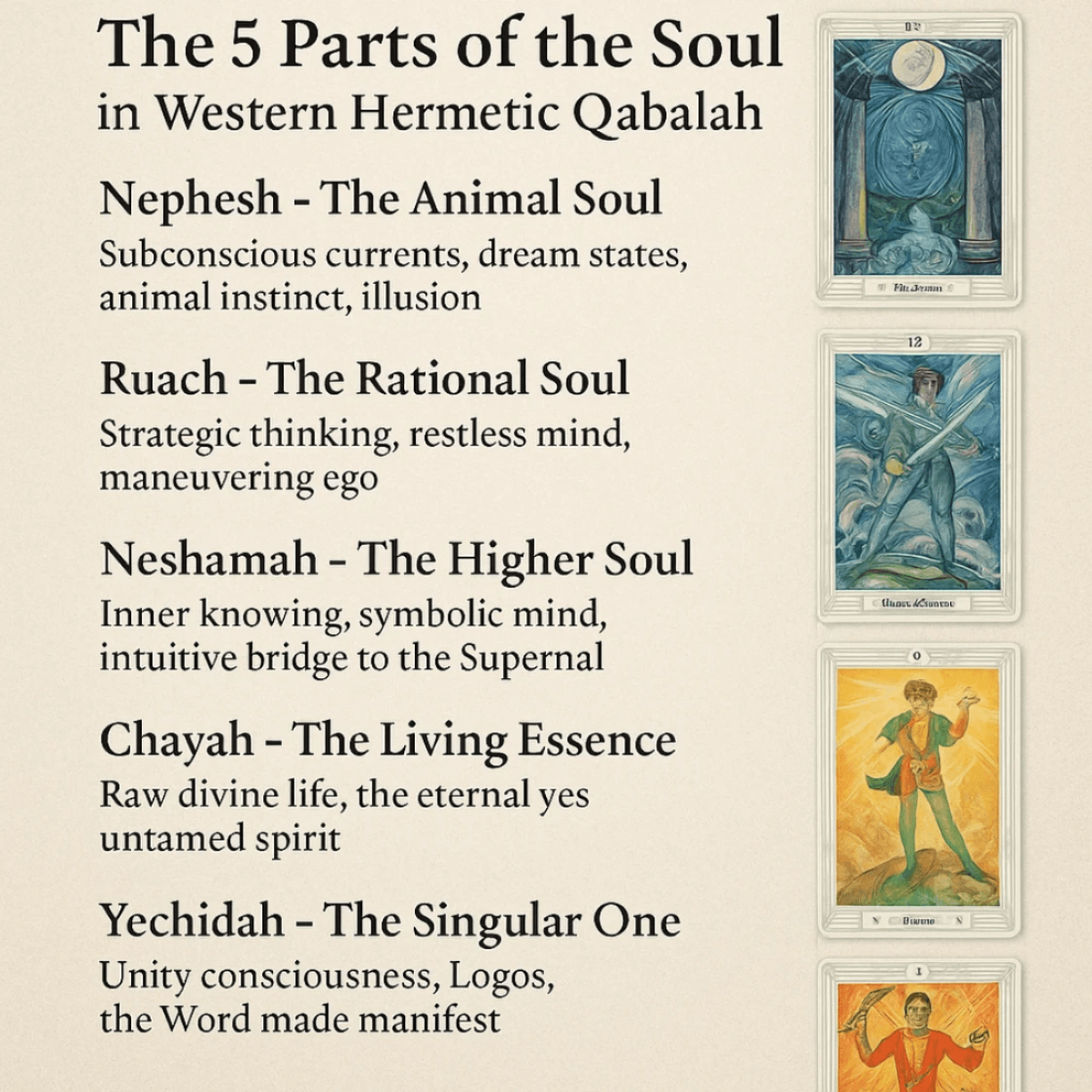
The Six as the Number of the Soul
The Sixes of Tarot represent the harmonizing influence of the Soul upon the personality. They indicate moments in which the fragmented elements of human consciousness are brought into greater alignment.
The physical body, emotional nature, rational mind, imagination, and Will begin to cooperate rather than behave like five committee members arguing over one chair.
This inner harmony produces what is traditionally called success. Yet Hermetic success is not merely the acquisition of money, reputation, or authority. It is the ability to express the intention of the Higher Self through thought, feeling, and action.
The Six of Pentacles therefore describes material success when material life has been brought into conformity with the principle of balanced exchange.
One person possesses resources. Another possesses a need. When the exchange is intelligent and just, both participate in the restoration of equilibrium.
The Solar Self and the Fragmented Psyche
Esoterically, the wealthy merchant may be understood as an image of the Solar Self. The two kneeling figures represent aspects of the personality that have become impoverished, neglected, or separated from the central light of consciousness.
These “beggars” may symbolize wounded emotions, undeveloped talents, rejected memories, or unconscious complexes seeking recognition and reintegration.
From a parapsychological perspective, the card illustrates the redistribution of psychic energy. When fear, repression, trauma, or social conditioning isolates portions of the psyche, those neglected elements continue to demand attention. They may appear through dreams, compulsions, projections, synchronicities, or emotional reactions that seem disproportionate to the immediate situation.
The Solar Self does not destroy these fragmented parts. It nourishes, reorganizes, and restores them to their proper place within the psychic system.
The act of giving in this card is therefore also an act of inner healing.

The Scales of Ma’at
The merchant’s scales recall the scales of Ma’at, the ancient Egyptian principle of truth, justice, balance, and cosmic order. In Egyptian theology, the heart of the deceased was weighed against the feather of Ma’at.
Likewise, the Six of Pentacles asks us to weigh the heart behind every exchange.
Is the gift truly generous?
Is it being used to establish dependency?
Is the receiver genuinely in need?
Is the giver attempting to purchase affection, loyalty, admiration, or obedience?
The scales reveal that charity is not automatically righteous simply because money changes hands. Giving may liberate, but it may also manipulate. Receiving may restore dignity, but it may also become habitual dependence.
True generosity preserves the sovereignty of both giver and receiver.
The Sacrifice Hidden Within Success
The number six is also associated with the mystery of the sacrificed and resurrected gods: Osiris, Christ, Dionysus, and other Solar figures who descend, suffer dissolution, and return transformed.
This pattern reveals an important Hermetic law: genuine accomplishment requires sacrifice.
The sacrifice is not necessarily physical suffering, nor does the universe demand misery as an entrance fee. Rather, the aspirant must relinquish habits, identities, attachments, and illusions that obstruct the expression of the Higher Self.
The personality must be reorganized around the Soul.
In practical life, prosperity follows the same principle. A successful enterprise requires the sacrifice of wasted time, obsolete methods, unnecessary expenses, poor planning, and occasionally the cherished belief that one can become wealthy while doing absolutely nothing.
The scales of the Six of Pentacles therefore represent the intelligent reallocation of energy. What is stagnant must be released so that what is vital may grow.

Alchemical Correspondence: Carbon and the Architecture of Life
The number six also has an intriguing scientific correspondence through carbon, the principal structural element of organic life.
Every carbon atom contains six protons and six electrons. The most common isotope, carbon-12, also contains six neutrons. Carbon is exceptionally capable of bonding with other elements, allowing it to form the complex molecular structures necessary for living organisms.
Symbolically, carbon demonstrates the creative power of relationship. It does not produce the architecture of life by remaining isolated. It bonds, connects, exchanges, and builds.
The Six of Pentacles expresses the same principle in the material world. Wealth becomes productive through relationship. Knowledge becomes useful when communicated. Love becomes transformative when expressed. Spiritual illumination becomes service when brought into embodied action.
This is alchemy in practical clothing: energy changes form, enters relationship, and becomes something greater than its original condition.
The Law of Circulation
Metaphysically, the Six of Pentacles illustrates the Law of Circulation. All manifested systems depend upon movement and exchange.
Blood must circulate through the body.
Breath must move through the lungs.
Water must flow or become stagnant.
Thought must be expressed or become obsession.
Wealth must circulate or become sterile accumulation.
This does not mean that saving money is spiritually improper. A reservoir is useful; a swamp is not. The issue is whether stored resources remain part of a living system or have become objects of fear, identity, and control.
The card teaches balanced circulation: preserve enough to maintain stability, distribute enough to support growth, and do not confuse generosity with financial self-destruction.
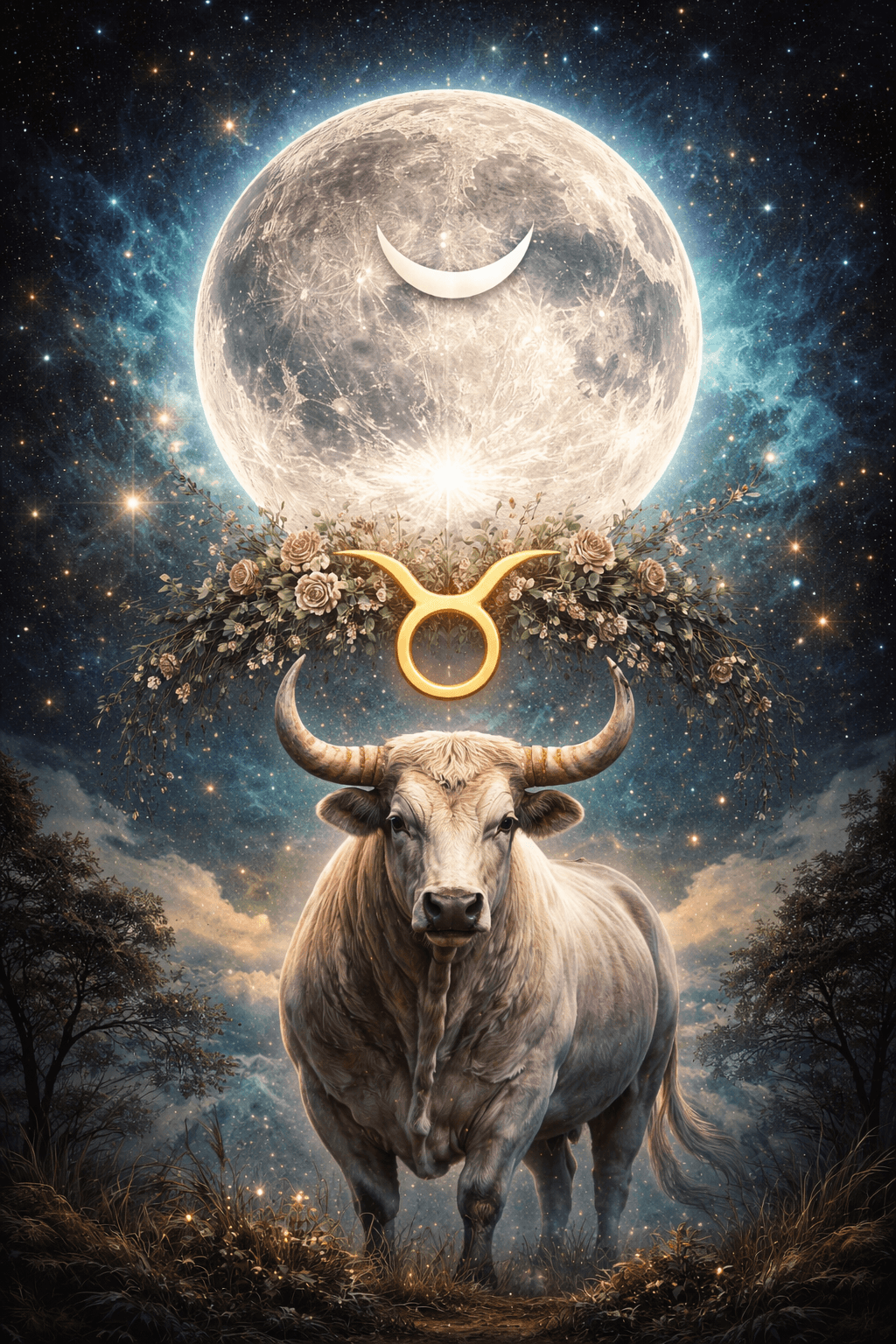
Astrologically to the Moon in Taurus, traditionally assigned to the second decan of Taurus, approximately 10°–20°.
The Moon represents emotion, instinct, memory, receptivity, habit, nourishment, and the subconscious mind. Taurus is a fixed Earth sign ruled by Venus and associated with stability, fertility, sensuality, endurance, value, and material security.
The Moon is traditionally considered exalted in Taurus. Here, the fluctuating lunar nature finds stability within the fertile and dependable field of Earth.
This combination produces emotional nourishment through tangible forms: food, shelter, touch, financial security, beauty, music, and dependable relationships.
In the Six of Pentacles, the Moon in Taurus expresses itself through practical care. Compassion becomes food on the table, money for the rent, fair wages, useful assistance, and resources placed where they can actually help.
It is kindness with shoes on.
Emotional Stability and Material Security
The Moon in Taurus seeks emotional peace through stability, predictability, and physical comfort. This placement tends to respond to emotional difficulties slowly and practically rather than dramatically.
Its virtues include patience, resilience, loyalty, endurance, and the ability to remain calm during periods of uncertainty.
However, its shadow may become possessiveness, complacency, emotional stubbornness, or an excessive attachment to material security.
The Six of Pentacles reflects both possibilities. Material resources may be used to nourish life, or they may become a means of controlling others. Security may create peace, or it may become a fortress against change.
The difference lies in consciousness.
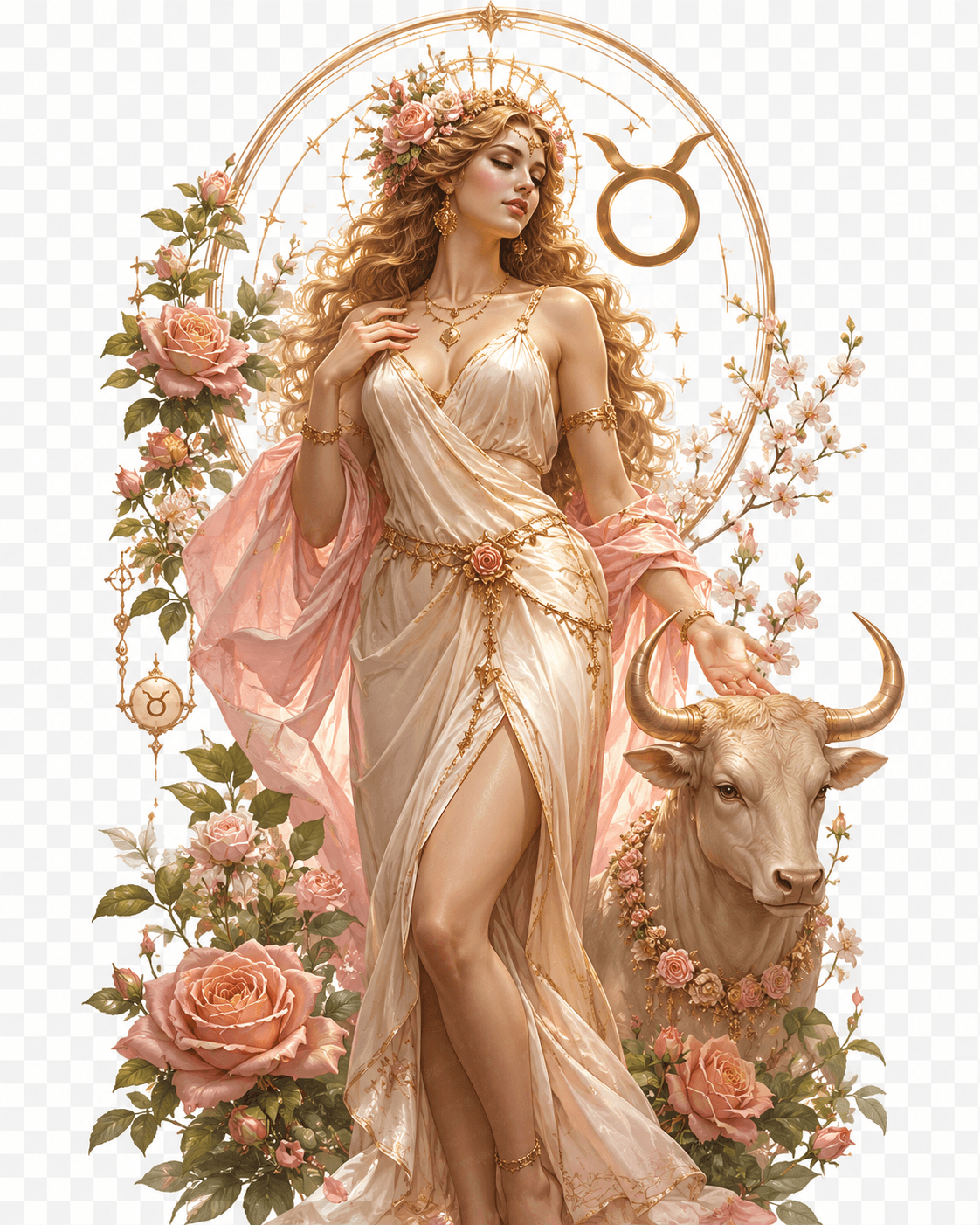
Sensuality and Embodied Blessing
Because Taurus is ruled by Venus, the Moon in Taurus recognizes that emotional and spiritual nourishment often arrive through the senses.
A warm meal, comforting music, a beautiful home, affectionate touch, and time spent in nature can restore psychic equilibrium. The card reminds us that spirituality does not require contempt for the material world.
Matter is not the enemy of Spirit. Matter is the field through which Spirit becomes experience.
In Hermetic theology, the physical world is not a cosmic mistake from which the Soul must flee. It is the final condensation of Divine energy through the Four Worlds of Qabalah. The task is not to reject matter, but to sanctify it through conscious use.
The Six of Pentacles therefore teaches that providing physical comfort, financial assistance, or material support may be a genuinely sacred act.
Sometimes enlightenment looks like a brilliant vision in meditation. Sometimes it looks like paying someone’s electric bill.
The Theology of Giving and Receiving
Theologically, giving and receiving are two phases of one Divine current.
The giver represents the outgoing, radiant, or projective force. The receiver represents the receptive, formative, and embodied force. Neither is superior. Both are necessary for manifestation.
A universe that only gave would empty itself into abstraction. A universe that only received would become motionless and congested. Creation requires pulsation: emanation and return, expansion and contraction, radiation and reception.

This is reflected in the Qabalistic formula of the Lightning Flash descending through the Tree of Life and the Serpent Path rising back toward its Source.
The Six of Pentacles places this cosmological law into an ordinary human scene. One hand opens and another receives. Yet beneath the visible transaction, Divine energy is circulating through its own creation.
The Shadow of Charity
The darker expression of this card appears when assistance contains concealed conditions.
The giver may expect loyalty, submission, admiration, political influence, emotional repayment, or public recognition. Charity then becomes a costume worn by control.
Likewise, the receiver may manipulate sympathy, avoid responsibility, or become dependent upon continual rescue.
The reversed or shadowed Six of Pentacles may therefore indicate:
- Unequal exchanges
- Exploitation disguised as generosity
- Gifts with hidden conditions
- Unpaid debts
- Financial manipulation
- Dependency
- Underpayment or unfair wages
- Giving beyond one’s healthy limits
- Refusing assistance because of pride
- Philanthropy used for status or control
The card asks not only, “What is being given?” but also, “What invisible contract accompanies the gift?”
Divinatory Meaning
Upright — The Light
The upright Six of Pentacles indicates generosity, financial assistance, philanthropy, fair exchange, material success, repayment, shared resources, patronage, and the restoration of balance.
It may suggest that help is available or that the querent is in a position to assist another. It can also represent fair compensation, a successful business transaction, recognition of value, or prosperity created through cooperation.
At its highest level, it signifies the understanding that wealth increases in meaning when it contributes to life beyond the isolated self.
Reversed — The Shadow
Reversed, the card may indicate unequal exchange, exploitation, financial dependency, debt, selfishness, unpaid obligations, manipulative generosity, or assistance given with strings attached.
It may also warn against giving too much out of guilt, fear, or the desire to be needed. Generosity without discrimination can become self-neglect, while receiving without responsibility can become dependence.
The remedy is the restoration of equilibrium.
Final Hermetic Reflection
The Rider–Waite–Smith Six of Pentacles is not merely a picture of a wealthy man giving money to the poor. It is an image of Solar order entering material exchange.
Tiphareth radiates through the suit of Earth, teaching that prosperity reaches its most beautiful expression when it is directed by wisdom, balance, and compassion.
The merchant, the scales, the coins, and the kneeling figures form a complete symbolic equation:
Power must be balanced by justice.
Wealth must be balanced by circulation.
Giving must be balanced by discernment.
Receiving must be balanced by responsibility.
The card reminds us that generosity is not measured solely by how much we give, but by whether the exchange strengthens dignity, restores equilibrium, and serves the greater harmony of life.
True prosperity is not merely having enough.
It is becoming a conscious channel through which abundance may flow.
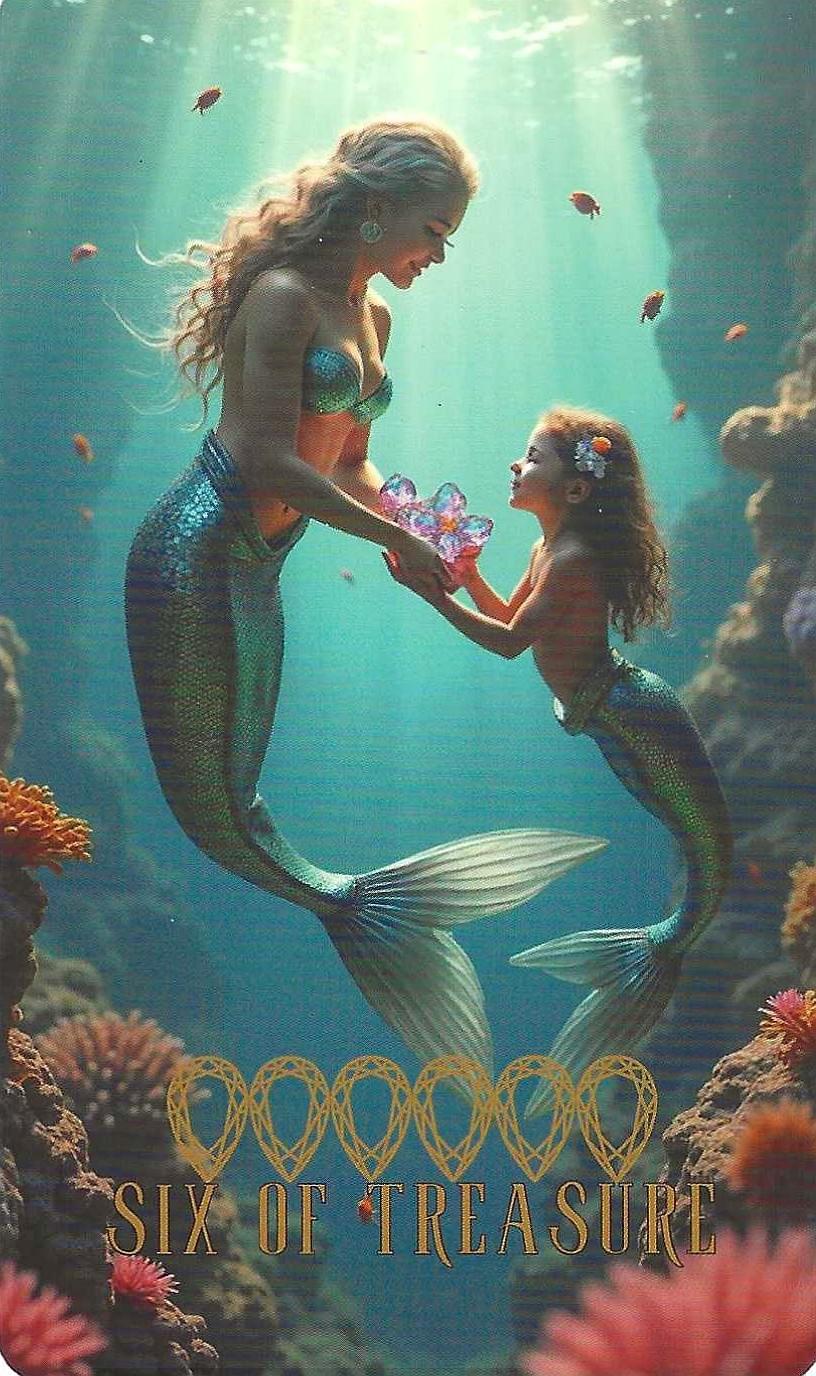
The Ocean Tarot Six of Treasure
Shared Abundance, Emotional Reciprocity, and the Wealth of the Living Sea
The Ocean Tarot Six of Treasure depicts mermaids sharing treasure beneath the sea. Rather than presenting wealth as the private possession of one powerful figure, the card places abundance within a communal and fluid environment.
Gold, jewels, and precious objects pass between the mermaids, suggesting generosity, cooperation, mutual assistance, and the circulation of resources. The underwater setting softens the rigid social hierarchy found in the Rider–Waite–Smith image. Here, giving and receiving appear less like charity bestowed from above and more like participation in a shared current.
The treasure belongs to the community because the sea itself recognizes no permanent boundary. Currents move, tides rise and fall, and even the most stubborn coin eventually discovers that it cannot swim upstream forever.
At its most immediate level, the card represents kindness, support, gifts, fair exchange, generosity, shared prosperity, and the willingness to help others through material or emotional difficulty.
Treasure as Crystallized Value
In the Ocean Tarot, the suit of Treasure corresponds to the element of Earth and therefore to the material foundations of life: health, money, work, security, resources, the body, and the practical results of human effort.
Yet treasure is more than currency. A treasure is anything regarded as precious.
It may be:
- Material wealth
- Knowledge
- Time
- Emotional support
- Skill
- Shelter
- Food
- Opportunity
- Healing
- Trust
The card therefore asks a deeper question than, “How much do you possess?”
It asks, “What do you value, and how wisely do you share it?”
A person may have little money and still be rich in courage, compassion, knowledge, or practical skill. Another may possess vast wealth yet live in spiritual poverty because nothing is allowed to circulate beyond the walls of the private self.
The Six of Treasure teaches that value becomes living treasure only when it participates in relationship.
The Number Six and the Solar Heart
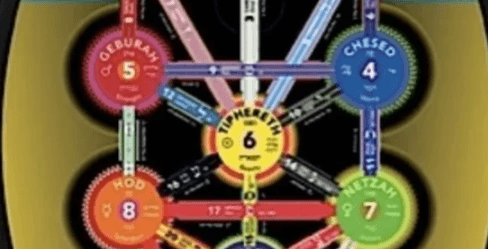
Like every Six in Tarot, the Six of Treasure belongs symbolically to Tiphareth, the sixth Sephira on the Qabalistic Tree of Life.
Tiphareth means Beauty and represents the Solar Self, the Soul, the Higher Will, and the harmonizing center of consciousness. It is the radiant heart of the Tree, balancing the expansive force of Chesed with the corrective severity of Geburah.
Within the watery imagery of the Ocean Tarot, this Solar principle is not shown as a blazing disk in the heavens. Instead, it appears as an inner light illuminating the depths.
This is an important metaphysical teaching. Solar consciousness is not limited to brilliance, glory, or visible achievement. It may also reveal itself quietly through compassion, generosity, and the instinct to restore balance wherever imbalance is found.
The mermaids sharing their treasure act as agents of Tiphareth. They distribute value in a manner that sustains relationship and strengthens the community.
The Sun Beneath the Sea
At first, the idea of Solar consciousness beneath the ocean may seem contradictory. Fire and Water are traditionally opposing elements. Yet this apparent contradiction is precisely where the Hermetic mystery appears.
The Sun represents the central identity of the Soul.
The sea represents the subconscious, the emotional body, the Collective Unconscious, and the Great Waters of Binah.
When Solar consciousness enters the sea, light descends into the hidden regions of the psyche. What was unconscious becomes visible. What was isolated becomes connected. What was emotionally impoverished receives nourishment.
The Six of Treasure therefore depicts the Solar Self distributing psychic and material resources throughout the watery depths of consciousness.
It is the inner Sun remembering that even the forgotten caves of the psyche deserve illumination.
The Mermaids as Powers of the Subconscious
Mermaids are hybrid beings, part human and part aquatic. Symbolically, they unite self-aware intelligence with the instinctive and emotional powers of the deep.
In parapsychological terms, they may represent intuitive faculties, dream consciousness, mediumistic sensitivity, emotional memory, and subtle impressions arising from below the threshold of ordinary awareness.
Their sharing of treasure suggests communication between different levels of the psyche.
One part of the personality may possess confidence but lack tenderness.
Another may possess imagination but lack discipline.
Another may carry old pain yet also contain forgotten wisdom.
Healing occurs when these isolated psychic regions begin to exchange their gifts.
The Six of Treasure therefore symbolizes psychic reciprocity. The conscious mind does not merely command the subconscious, nor does the subconscious drown rational awareness in a storm of unexamined emotion. Each contributes something valuable to the wholeness of the individual.

The Great Sea of Binah
Cosmologically, the ocean corresponds to Binah, the Great Sea of Understanding. Binah is the third Sephira and the archetypal matrix through which Divine force receives form.
She is the womb of structure, memory, limitation, and manifestation.
All created forms emerge through this Great Sea, and all forms eventually return to it. The treasure scattered throughout the underwater world may therefore be understood as condensed fragments of Divine possibility.
Gold, jewels, pearls, and crystals symbolize spiritual light that has been compressed into form. They are sparks of value hidden within the depths of matter and consciousness.
When the mermaids share these treasures, they participate in the cosmic work of redistribution. What was hidden becomes available. What was concentrated in one place enters a wider pattern of usefulness.
This is the theology of abundance as circulation rather than possession.
The Moon in Taurus
The Six of Treasure, like the Rider–Waite–Smith Six of Pentacles, corresponds astrologically to the Moon in Taurus, traditionally associated with the second decan of Taurus.
The Moon governs emotion, receptivity, memory, nourishment, instinct, and the subconscious. Taurus is fixed Earth, ruled by Venus, and represents stability, embodiment, fertility, beauty, comfort, resources, and material value.
The Moon is exalted in Taurus because the changing lunar nature finds calmness and stability within the fertile body of Earth.
In the Ocean Tarot image, the lunar element is especially strong because the Moon rules tides, rhythm, instinct, and the hidden movements of the sea. Taurus provides the treasure itself: the tangible forms of security, beauty, nourishment, and value.
Together, they create the impulse to care for others in practical ways.
This is emotional concern made material.
It does not merely say, “I hope you feel better.”
It brings soup, blankets, money, shelter, or whatever else keeps the ship from sinking.
Emotional Reciprocity
The mermaids sharing treasure emphasize that giving and receiving are emotional acts as well as material ones.
People often attach complex feelings to generosity. The giver may feel powerful, compassionate, obligated, guilty, superior, loving, or afraid of rejection. The receiver may feel grateful, relieved, embarrassed, indebted, vulnerable, or resentful.
The Six of Treasure asks both parties to examine these emotional currents.
Healthy exchange allows dignity to remain intact. The giver does not use wealth to dominate. The receiver does not surrender personal sovereignty in exchange for assistance.
True reciprocity does not always mean that equal material value is immediately returned. A person receiving help today may support someone else tomorrow. The current continues even when it does not flow back through the same hands.
The Law of Tides
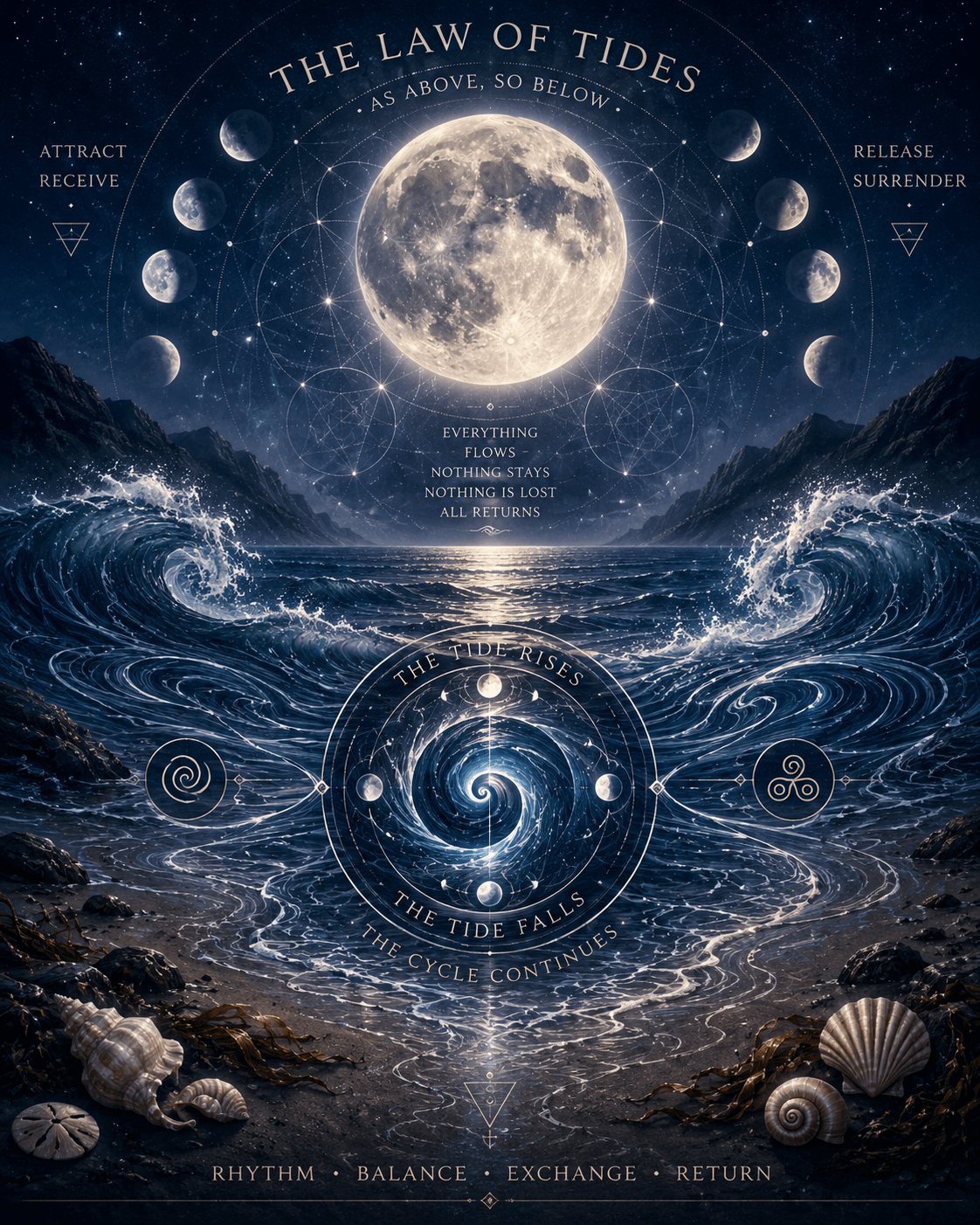
Metaphysically, the Ocean Tarot Six of Treasure expresses the Law of Tides.
All life moves through alternating cycles of fullness and emptiness, giving and receiving, expansion and contraction. No one remains permanently in the position of giver, and no one remains permanently in the position of receiver.
There are seasons when we possess strength, resources, clarity, or wisdom that others require. There are also seasons when we must accept help.
The ego often prefers giving because giving appears powerful. Receiving requires vulnerability. Yet refusing assistance can be as imbalanced as refusing to share.
The card teaches that both movements belong to one current.
The tide that goes out must eventually return.
The sea keeps no tiny ledger beneath a coral reef.
Prosperity as Relationship
Modern culture often defines prosperity as personal accumulation. The Ocean Tarot offers a more organic definition.
A coral reef is prosperous not because one creature owns everything, but because countless forms of life participate in a complex network of exchange.
Nutrients circulate.
Shelter is created.
Waste becomes nourishment.
Different species contribute to the stability of the whole.
Likewise, human prosperity is relational. Businesses depend upon customers, workers, suppliers, communities, ecosystems, and shared systems of trust. Wealth never arises in absolute isolation.
The Six of Treasure reminds us that individual success is sustained by visible and invisible networks of cooperation.
No one becomes a self-made mermaid. Someone had to build the coral shelf.
The Gift of the Soul
Theologically, the treasures may symbolize the gifts of the Soul distributed throughout creation.
Each person enters life with particular abilities, insights, sensitivities, and potentials. These gifts are not intended solely for personal glorification. They are instruments through which the Divine Creative expresses itself in the world.
One person teaches.
Another heals.
Another builds.
Another protects.
Another brings beauty, laughter, organization, nourishment, or wisdom.
The Six of Treasure asks whether these gifts are being circulated or hidden.
A talent withheld through fear is like gold buried beneath the seabed. It exists, but it serves no living purpose.
The Soul gives freely because expression is its nature. The human personality must learn to do the same without becoming reckless, depleted, or self-sacrificing to the point of resentment.
Generosity and Healthy Boundaries
The card’s positive message should not be mistaken for unlimited giving.
The element of Earth requires boundaries, measurement, and practical judgment. Sustainable generosity does not impoverish the giver or enable the receiver to avoid necessary growth.
Healthy giving asks:
- Is this assistance truly useful?
- Does it preserve dignity?
- Am I giving freely or from guilt?
- Am I supporting growth or maintaining dependency?
- Can I give without damaging my own stability?
The Six of Treasure is not a command to empty the treasure chest simply because someone arrives with a sad expression.
Compassion requires an open heart.
Wisdom occasionally requires a locked lid.
The Shadow of the Underwater Gift
In shadow, the sharing of treasure may conceal manipulation, favoritism, emotional bargaining, dependency, or unequal exchange.
A gift may carry an invisible hook.
Support may be offered in exchange for affection, loyalty, secrecy, obedience, or admiration. The giver may repeatedly rescue others because being needed provides a sense of identity or power.
The receiver may also misuse generosity, taking without gratitude, effort, or responsibility.
The shadowed Six of Treasure may therefore indicate:
- Gifts with conditions
- Emotional indebtedness
- Financial dependency
- Manipulative generosity
- Unequal distribution
- Favoritism
- Exploitation
- Taking more than one gives
- Refusing help because of pride
- Giving until resentment develops
- Confusing rescue with love
The card asks us to examine what moves beneath the visible exchange. The ocean may appear calm at the surface while a powerful current is operating below.
Divinatory Meaning
Upright — The Light
Upright, the Ocean Tarot Six of Treasure indicates generosity, shared resources, community support, gifts, charity, fair exchange, repayment, assistance, cooperation, gratitude, and material improvement.
It may represent receiving help during a difficult period or becoming able to support another person. It can also indicate a fair business agreement, balanced finances, successful collaboration, or the sharing of knowledge and opportunity.
At its highest level, it represents abundance flowing through a network of mutual care.
Reversed — The Shadow
Reversed, the card may indicate unequal exchange, dependency, selfishness, exploitation, unpaid debts, manipulation, false charity, or help that comes with hidden conditions.
It may also warn that the querent is giving too much, refusing necessary support, or measuring personal worth by how useful they are to others.
The reversal asks for a restoration of boundaries and a more honest evaluation of the emotional motives behind giving and receiving.
Ocean Tarot and Rider–Waite–Smith Comparison
The Rider–Waite–Smith Six of Pentacles emphasizes hierarchy. One wealthy figure distributes coins while two supplicants kneel before him. The scales suggest justice, judgment, and measured allocation.
The Ocean Tarot Six of Treasure emphasizes community. The mermaids share treasure within a common environment, suggesting a more fluid and reciprocal model of abundance.
The Rider–Waite–Smith card asks:
Who possesses the resources, and how fairly are they distributed?
The Ocean Tarot asks:
How does abundance move through the living community?
One image focuses on social power and responsibility.
The other focuses on emotional reciprocity and shared participation.
Together, they reveal the complete mystery of the Six: prosperity must be both wisely measured and freely circulated.
Final Hermetic Reflection
The Ocean Tarot Six of Treasure teaches that wealth is not truly alive until it enters relationship.
The gold beneath the sea may symbolize money, but it may also represent love, wisdom, time, talent, healing, or opportunity. Whatever form the treasure takes, its spiritual value is revealed through conscious exchange.
The card unites the Solar harmony of Tiphareth, the lunar tides of the subconscious, the fertile stability of Taurus, and the Great Sea of Binah.
Its message is both mystical and practical:
Give without domination.
Receive without shame.
Share without self-destruction.
Preserve without hoarding.
Allow value to circulate.
The sea remains abundant because it is always moving.
So does the Soul.
Thank you for reading, sharing your thoughts, subscribing freely, and supporting this work through your generous donations. Your encouragement helps keep these blogs alive, growing, and available to everyone seeking this knowledge. I am deeply grateful that you are part of this community.
May you live long and prosper.
3 Western Hermetic Tarot and Magick websites helping people become more magick and less tragic since 2010.
Traditional Tarot Card Comparisons blog and tarot reading store.
Tarot Home Page, Tarot Store, Master Thoth Tarot Classes, and nontraditional Tarot Card Blog.
Western Hermetic magick ritual and invocation website and magick blogs.
