
elitarot2strikingly.com
Above all things, know thyself!

The Ocean Tarot- Seven of Treasure

Radiant Edition: Rider-Waite-Smith Tarot- Seven of Pentacles
The Rider–Waite–Smith Seven of Pentacles
Victory After a Very Long Lunch Break
The Sevens of Tarot are governed by Netzach, the seventh Sephirah on the Tree of Life. Netzach means Victory, which sounds glorious until one remembers that victory generally requires a battle—and sometimes the prize is scarcely worth the bruises.
The Rider–Waite–Smith Seven of Pentacles depicts a weary farmer leaning upon his hoe while contemplating the results of his labor. Six Pentacles grow from the shrub before him, while a seventh rests near his feet. His posture suggests exhaustion rather than celebration.
Even the gray sky seems tired.
This is not the joyful abundance of a completed harvest. It is the uncomfortable pause in which one asks:
“After all that work, is this really all I have to show for it?”
The card therefore represents delayed gratification, diminished returns, fatigue, evaluation, and the frustration of waiting for material results. Yet it also contains an important spiritual instruction: what appears unproductive may still be gestating beneath the surface.
Seeds do not provide daily progress reports. Rather inconsiderate of them, really.
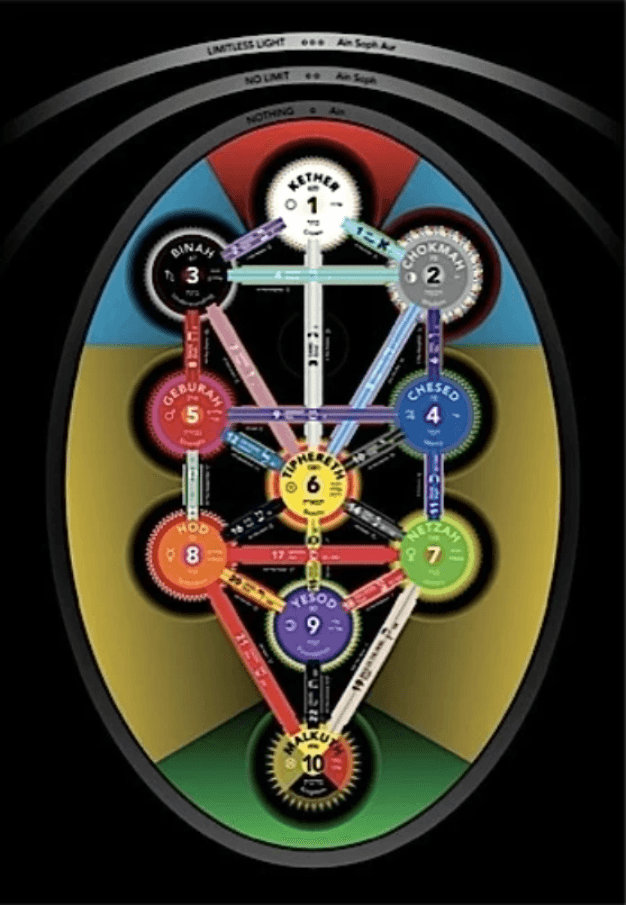
Netzach: The Trial of Desire
Netzach is the Venusian sphere of desire, instinct, emotion, imagination, attraction, beauty, and endurance. It is the passionate force that urges life to continue growing.
However, the Seven of Pentacles belongs to the heavy element of Earth. Within this dense material field, the flowing, pleasurable force of Venus becomes restricted. Beauty turns into labor, desire becomes impatience, and natural growth appears painfully slow.
The problem is not necessarily that nothing is happening. The problem is that the visible results do not yet satisfy the expectations of the conscious mind.
In Western Hermetic Qabalah, the Sevens often represent unstable elemental conditions. Netzach lies below Tiphareth, the sphere of Solar balance, and therefore its emotional and instinctive powers may become distorted when they are not directed by the Higher Self.
In the Seven of Pentacles, Earth has fallen out of harmonious regulation. Material concerns begin generating anxiety, discouragement, and fear of failure. The imagination, rather than serving manifestation, begins producing gloomy predictions about finances, health, work, or relationships.
Netzach then becomes less “Victory” and more “Victory is currently experiencing shipping delays.”

Saturn in Taurus
Astrologically, the Seven of Pentacles corresponds to Saturn in Taurus.
Saturn represents time, discipline, limitation, structure, responsibility, endurance, and the inevitable consequences of cause and effect. Taurus is fixed Earth: stable, fertile, patient, sensual, and resistant to sudden change.
Together, Saturn and Taurus produce extraordinarily slow material development.
Taurus plods forward at the pace of an Earth bull, while Saturn adds the proverbial lead weight. Saturn’s traditional metal is lead, and its mythological form is Kronos, the devourer and measurer of time. Thus, the card portrays manifestation subjected to delay, gravity, and necessity.
This combination can indicate:
- Slow but potentially lasting growth
- Financial caution or anxiety
- Strong endurance and work ethic
- Resistance to change
- Frustration with delayed results
- The need to reassess investments of time, energy, or money
Saturn in Taurus teaches that durable manifestation cannot always be rushed. The foundation must be strong enough to support what is being created.
However, patience must not become stagnation. Persistence is a virtue; endlessly repeating an ineffective method is merely stubbornness wearing ceremonial robes.

The Number Seven
Seven is one of the great mystical numbers of Western esotericism. It appears in the seven classical planets, the seven planetary metals, the seven days of the week, and numerous sevenfold systems of initiation and transformation.
In classical numerology, seven represents introspection, spiritual inquiry, solitude, discernment, and the search for hidden truth. It is the number of the mystic who looks beneath appearances rather than accepting the surface explanation.
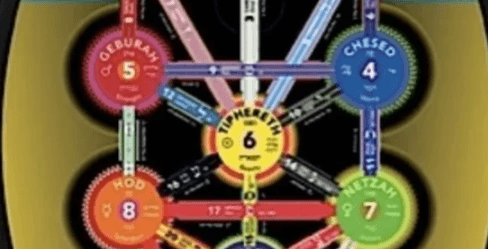
On the Tree of Life, seven belongs to Netzach and therefore concerns the emotional, instinctive, artistic, and psychic forces of consciousness. These powers can inspire spiritual ascent, but they can also produce glamour, fantasy, temptation, and discouragement.
The Thoth Tarot illustrates this instability through its four Sevens:
- Seven of Wands—Valour: courage under pressure
- Seven of Cups—Debauch: emotional and astral excess
- Seven of Swords—Futility: unstable or divided thought
- Seven of Disks—Failure: stagnation and poor material fruition
These cards do not necessarily predict permanent defeat. Rather, they reveal elemental forces that have temporarily fallen out of balance.
Seven therefore tests whether the aspirant can remain centered when desire, emotion, thought, or material circumstances refuse to behave politely.

Zayin: The Sword of Discernment
The seventh Hebrew letter is Zayin, meaning “sword.” Its numerical value is seven.
Although Hebrew letters and Sephiroth should not be treated as interchangeable correspondences, Zayin offers a valuable symbolic key to the number Seven.
The sword separates, distinguishes, and clarifies. It cuts truth away from illusion.
The Seven of Pentacles asks the querent to use this sword of discernment upon their own labor:
- Is the project genuinely failing?
- Is it simply developing slowly?
- Are the methods effective?
- Has emotional discouragement distorted perception?
- Is persistence required, or is a new approach necessary?
The card does not advise blind perseverance. It advises conscious evaluation.

The Trial of Sisyphus
The weary farmer evokes the Greek myth of Sisyphus, who was condemned to push a great stone uphill, only to watch it roll back down each time he approached the summit.
The myth has become a symbol of futility, repetition, and existential frustration. Yet through a Hermetic lens, Sisyphus may also represent the soul’s repeated struggle to master the density of incarnation.
The stone corresponds symbolically to matter and the gravitational attachments of Malkuth, the physical kingdom. The mountain represents spiritual ascent through the Tree of Life. Each fall back toward the bottom reflects the repeated cycles of discipline, purification, incarnation, and self-correction required before consciousness can stabilize at a higher level.
Sisyphus may therefore be understood not merely as a punished man, but as an image of the Great Work performed under conditions of resistance.
His cycle particularly resonates with Atu X, Fortune, whose turning wheel represents recurring patterns, karmic momentum, and the rise and fall of manifested conditions.
It may also be compared with Atu XVI, The Tower, although its correct Qabalistic path is the Path of Peh between Hod and Netzach—not between Hod and Geburah. The Tower represents the destruction of false structures, while Sisyphus portrays the exhausting repetition that continues until the lesson hidden within the cycle is recognized.
The question is not merely, “How do I push harder?”
The deeper question is, “Why does the stone keep rolling back?”
Putrefaction Before Purification
Alchemy teaches that decomposition often precedes transformation. Before a substance can be purified, its old structure must first break down. Hence, compost.
This stage is sometimes compared with putrefactio or the blackening phase of the Great Work. What appears to be failure may actually be the dissolution of an inadequate form.

The Seven of Pentacles can therefore represent the discouraging stage in which an old approach has exhausted itself, but the new form has not yet emerged. The field appears barren because its previous cycle is ending.
Here, the “lowest fallen may become the highest exalted.” The apparent failure becomes the raw material of wisdom.
A poor harvest reveals something:
- The soil may require renewal.
- The method may need correction.
- The expectations may have been unrealistic.
- The timing may not yet be ripe.
- The project may need greater discipline—or merciful release.
Failure becomes spiritually useful when it is examined rather than merely feared.
Parapsychological and Metaphysical Meaning
Parapsychologically, the Seven of Pentacles can indicate a feedback loop between expectation and manifestation.
Repeated thoughts of failure may charge the emotional and astral fields with discouragement. This does not mean that every hardship is magically self-created. Material conditions, economic systems, health, timing, and circumstance remain real factors.
However, the mind’s interpretation of delay can either strengthen or weaken the individual’s ability to respond.
When fear dominates Netzach, imagination generates images of defeat. These images stimulate bodily stress, reduce motivation, and encourage withdrawal. The person then behaves as though failure has already occurred, creating a self-reinforcing pattern.
The card advises the querent to distinguish between an actual external obstacle and an internally amplified fear of failure.
The brain may be announcing catastrophe while the deeper psyche is simply saying:
“Continue—but make adjustments.”

The Seven Hathors and the Mystery of Destiny
The number Seven may also be contemplated through the Egyptian image of the Seven Hathors, divine feminine figures associated with birth, destiny, protection, music, joy, and the announcement of a newborn child’s fate.
Hathor’s Venusian qualities harmonize naturally with Netzach: love, beauty, fertility, pleasure, music, attraction, and emotional intelligence.
From a modern Hermetic perspective, the Seven Hathors may be approached as symbolic guardians of incarnational destiny—the powers that oversee the soul’s entry into embodied life and the unfolding of its potential.
Egyptian cosmology also linked Orion with Osiris and Sirius with Isis, Sopdet, and the renewal associated with the Nile. These stellar connections provide a powerful contemplative framework for resurrection, fertility, cosmic order, and spiritual rebirth.
However, it is wise to distinguish historical Egyptian theology from later esoteric interpretation. The Seven Hathors can be symbolically related to Netzach and stellar initiation without claiming that ancient Egyptian texts formally taught the modern Hermetic Tree of Life.
The magician should build bridges between traditions, not force one temple’s architecture onto another.
In practical work, the Seven Hathors may be contemplated as archetypal powers of:
- Destiny and spiritual potential
- Feminine wisdom
- Creative inspiration
- Emotional restoration
- Fertility of mind and matter
- Protection during transformation
- Rebirth after disappointment
Their presence reminds us that destiny is not always a finished decree. It may be a pattern of potential that must be consciously cultivated.
Esoteric Teaching of the Seven of Pentacles
The Seven of Pentacles teaches that material manifestation is governed by cycles, timing, discipline, and lawful consequence.
It asks the aspirant to examine the relationship between desire and effort. Desire alone cannot produce the harvest, but labor without conscious direction becomes mechanical and joyless.
The spiritual lesson is therefore threefold:
Patience: Allow the work sufficient time to mature.
Evaluation: Determine whether the present method is producing meaningful growth.
Persistence: Continue where the work remains aligned with the True Will.
The card does not promise that every project must succeed simply because one refuses to quit. Sometimes wisdom lies in pruning, restructuring, or planting elsewhere.
True perseverance is not an attachment to one method. It is loyalty to the purpose behind the work.
Divinatory Meaning
When the Seven of Pentacles appears in a reading, it often indicates fear of failure concerning finances, employment, health, relationships, or a long-term undertaking.
The querent may feel that their labor is endless and that completion remains forever out of reach. Yet the card often describes a temporary period of discouragement rather than a final outcome.
Because Netzach is an unstable emotional force within the element of Earth, the individual’s perception may be darker than the actual situation.
The project may still succeed if the querent remains determined, evaluates their methods, and refuses to surrender merely because progress is slow.
Traditional timing may point symbolically toward seven weeks or seven months, although Tarot timing should always be interpreted in relation to the surrounding cards and the circumstances of the reading.
Upright
- Hard work with delayed reward
- Patience and endurance
- Evaluation of progress
- Financial or material concern
- Fatigue and frustration
- Slow growth
- Reassessment of methods
- Waiting for results
- Persistence through an unproductive season
- Long-term investment
The message is:
Do not confuse slow progress with permanent failure. Examine the work, make the necessary corrections, and continue with conscious determination.
Reversed or Shadow Expression
- Wasted effort
- Poor planning
- Impatience
- Loss of motivation
- Abandoning the work prematurely
- Deep-rooted blockages
- Anxiety about money or security
- Repeating an ineffective strategy
- Laziness disguised as discouragement
- Remaining trapped in unproductive labor
When poorly defined by surrounding cards, the Seven of Pentacles warns that the querent may sink into a mire of resignation, sloth, or obsessive worry.
The solution is neither blind optimism nor despair. It is honest assessment followed by deliberate action.
Push where persistence is required. Prune where correction is required. Walk away where the soil is truly dead.
Even the wisest farmer eventually learns not to argue with a turnip.

The Ocean Tarot Seven of Treasure
The Ocean Tarot Seven of Treasure presents a far more encouraging vision of material development. A young mermaid sits comfortably upon the ocean floor, examining a treasure chest overflowing with gold coins. The chest is so full that its riches spill onto the seabed, suggesting that patience and sustained effort have finally produced visible results.
Unlike the weary farmer of the Rider–Waite–Smith card, this mermaid is not staring at a disappointing harvest. She is assessing abundance already gathered. Her task is no longer merely to endure, but to evaluate what has been gained and decide how best to preserve, develop, or distribute it.
The card therefore symbolizes:
- Rewards
- Harvest
- Progress
- Results
- Growth
- Patience
- Perseverance
- Long-term planning
Within the watery environment of the Ocean Tarot, treasure also carries an emotional and psychic meaning. The gold may represent not only money or possessions, but accumulated wisdom, creative potential, emotional maturity, and the valuable results of inner work.
The ocean is the great field of the subconscious. Thus, the overflowing chest may suggest that something once hidden beneath the surface has matured enough to be recognized and claimed.
In Qabalistic terms, the Seven remains governed by Netzach, the sphere of desire, instinct, imagination, and endurance. Yet here, the Venusian power of Netzach appears more productive. Desire has not been defeated by the heaviness of Earth; it has been patiently cultivated until it produces tangible value.
The mermaid’s relaxed posture also reminds us that growth need not always be accompanied by grim suffering. Sometimes persistence works quietly beneath the surface while the conscious mind is busy complaining that nothing is happening.
The ocean, apparently, does not provide progress notifications either.
The Shadow Side
Despite its abundant imagery, the Seven of Treasure still warns against complacency. A full chest may encourage the belief that no further effort is required, yet unfinished work can quickly turn prosperity into waste.
Its shadow meanings include:
- Insufficient growth
- Unfinished work
- Low effort
- Procrastination
- Impatience
- Setbacks
- Waste
- Poor planning
- Lack of reward
- Failing to protect what has already been gained
The card may therefore ask whether the querent is truly cultivating future prosperity or merely admiring past accomplishments.
Treasure that is not managed can be scattered. Potential that is not developed can stagnate. A harvest gathered without foresight may disappear before the next season begins.
Divinatory Meaning
When upright, the Ocean Tarot Seven of Treasure indicates that patient effort is beginning to produce meaningful results. The querent may be entering a period of reward, growth, financial improvement, emotional fulfillment, or successful long-term development.
It advises continued perseverance, careful evaluation, and intelligent planning.
When reversed or poorly defined by surrounding cards, it may indicate disappointment with progress, unfinished tasks, wasted resources, impatience, weak commitment, or the expectation of reward without sufficient labor.
The message is simple:
Appreciate what has grown, but do not stop tending the garden merely because the treasure chest finally looks impressive.
Final Reflection
The Seven of Pentacles is the uncomfortable interval between sowing and harvesting. It is the silence in which effort has been given, yet the universe has not delivered a receipt.
Under Saturn in Taurus, material results arrive slowly, heavily, and according to the uncompromising law of time. Under Netzach, discouragement may distort perception and tempt the aspirant to abandon the Great Work.
Yet this card also teaches that apparent failure can become the beginning of purification. Through patience, evaluation, and renewed intention, disappointment may be transformed into wisdom.
Victory is not always the triumphant raising of a banner.
Sometimes victory is simply returning to the field tomorrow—this time with a better plan.
Elizabeth and I Thank you for your interest, comments, free subscriptions, and supportive donations. Your generosity helps keep this knowledge available to everyone seeking it. May you live long and prosper!
3 Western Hermetic Magick Websites Helping people become more magick and less tragic since 2010.
Traditional Tarot Card Comparisons, tarot store and blogs.
Home page, Tarot Store, Master Thoth Tarot Class page and nontraditional Tarot Card Blog.
Western Hermetic Magick invocation and ritual website and Magick blogs.
